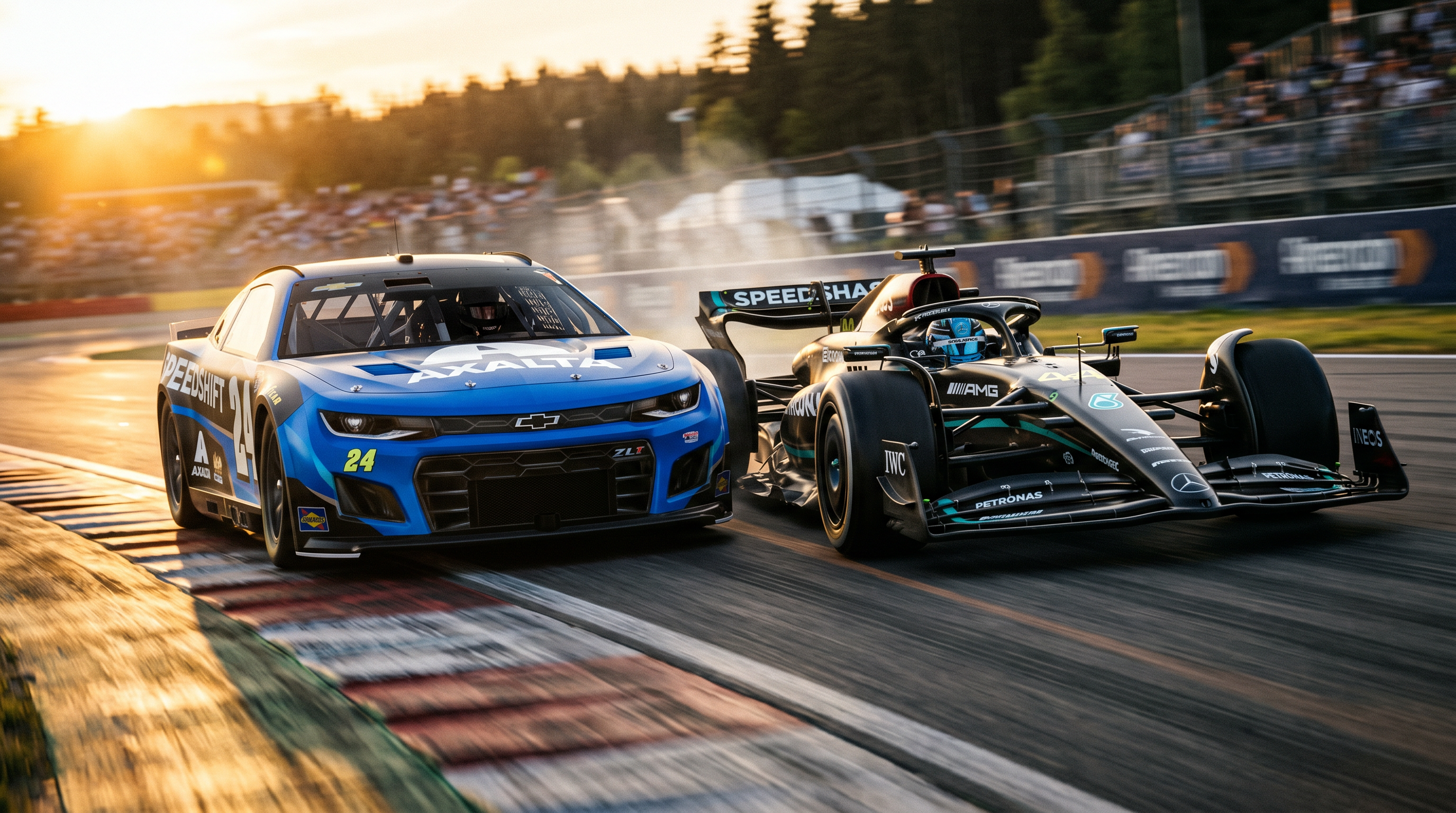
NASCAR vs F1 Speed: Top Speeds, Acceleration, and the COTA Lap Time Showdown
Imagine two titans of motorsport hurtling toward a shared horizon: a NASCAR stock car, all brute force and American muscle, clocking over 200 MPH (322 KPH) on a drafting frenzy at Daytona, versus a Formula 1 machine, a razor-sharp arrow slicing through the air at 230+ MPH (370+ KPH) on Monza's blistering straights. This isn't just a NASCAR vs F1 speed debate—it's a clash of engineering philosophies, where raw power meets precision aero wizardry. For motorsport fans and car enthusiasts, understanding these differences unlocks the thrill behind every lap. We'll dive deep into top speeds, acceleration, downforce's grip on corners, weight battles, and a head-to-head at Circuit of the Americas (COTA), all while demystifying MPH to KPH conversions.
Unleashing the Beasts: Comparing Racing Top Speeds
When it comes to racing top speed, Formula 1 cars hold the crown, but NASCAR's pack-racing dynamics make for a fiercely competitive narrative. F1 cars routinely exceed 230 MPH (370 KPH), with records pushing 231.4 MPH (372.5 KPH) set by Honda's Valtteri Bottas at the 2016 Mexican GP. These feats stem from hybrid power units delivering over 1,000 horsepower, paired with low-drag setups that turn the cars into ground-hugging missiles on long straights.
NASCAR Cup Series cars, by contrast, top out at 200+ MPH (322+ KPH), often hitting 205 MPH (330 KPH) during restrictor-plate races at Daytona or Talladega. The Next Gen car's 670-horsepower V8 thrives in the slipstream, where drafting shaves drag and boosts speeds dramatically. Without that pack effect, solos might cap at 190 MPH (306 KPH). It's a testament to motorsport engineering: F1 optimizes for solo purity, NASCAR for chaotic synergy.
Why the gap? Aerodynamics play kingmaker. F1's active aero and sleek profiles minimize resistance, while NASCAR's boxier shapes prioritize durability and close-quarters racing. Fans toggling between MPH and KPH—remember, 1 MPH ≈ 1.609 KPH—appreciate tools like the SpeedShift Converter for instant real-time swaps during broadcasts.
From Zero to Hero: Acceleration Showdown
F1's Lightning Launch vs NASCAR's Tire-Shredding Surge
Acceleration is where F1 flexes its tech dominance. Modern F1 cars blast from 0-60 MPH (0-97 KPH) in about 2.6 seconds, thanks to seamless paddle-shift gearboxes, traction control wizardry, and that hybrid boost injecting instant torque. Picture the Monaco start: tires screeching as 1,000+ HP catapults a featherweight chassis forward like a slingshot.
NASCAR counters with raw grunt. The Next Gen car hits 0-60 MPH (0-97 KPH) in roughly 3.4 seconds, propelled by a pushrod V8 that roars to life with sequential five-speed transmissions. Heavier at 3,200 lbs (1,451 kg), it relies on massive tires (18-inch fronts, 12.5-inch wide rears) for grip, but wheelspin is part of the drama—especially off pit stops.
- F1 Edge: Lighter weight, advanced energy recovery systems (ERS) for mid-accel punch.
- NASCAR Strength: Predictable power delivery suited to restarts amid traffic.
In the NASCAR vs F1 speed arena, this 0.8-second gap underscores philosophy: F1 for circuit sprints, NASCAR for endurance ovals.
Downforce: The Invisible Hand Guiding Cornering Mastery
Speed isn't just straight-line bravado; it's conquering turns at impossible velocities. Enter downforce—the aerodynamic magic pressing cars to the track. F1 generates up to 5G in corners, thanks to inverted wings, diffusers, and floor effects that suck the car down like a vacuum. At Suzuka's Spoon curve, drivers pull 4-5G, braking from 200 MPH (322 KPH) to apex at 100 MPH (161 KPH) without blinking.
NASCAR downforce is tamer, around 2-3G, with simpler spoilers and side skirts prioritizing stability over outright grip. At road courses like COTA, they lean on mechanical grip from suspension and tires. This lets stock cars slide thrillingly—drift angles that would spin an F1—but sacrifices ultimate corner speed.
Downforce turns speed into lap time; without it, even 230 MPH (370 KPH) straights mean nothing in the twisties.
This dynamic flips the racing top speed script: F1 slower on ovals sans downforce tweaks, NASCAR shining where drafting trumps aero.
Engineering Deep Dive: Weight, Aero, and Powertrain Secrets
Featherweight F1 vs Hefty NASCAR Hardware
At the heart of motorsport engineering lies stark contrasts. F1's minimum weight: 798 kg (1,759 lbs), including driver—a dieter's nightmare enforced by FIA scales. This lightness amplifies acceleration and agility, but demands halo safety and carbon tubs.
NASCAR mandates 1,451 kg (3,200 lbs) post-fuel, ballooning with steel tubes, lead ballast, and crash-proof cages. It's built for 500-mile slugfests, not quali laps.
Aerodynamics: Slice vs Slam
F1 aero is a symphony—ground effect floors channeling air for 3x the car's weight in downforce. NASCAR's is utilitarian: fixed rear spoilers (historically 6 inches, now taller) and underbody panels for baseline stability, avoiding F1's sensitivity to yaw.
- Power: F1 hybrid 1,000+ HP vs NASCAR 670 HP.
- Fuel: F1 sips 110 kg race fuel; NASCAR guzzles 18,000 lbs per event.
- Tires: F1 Pirellis last 50 laps; NASCAR Goodyears shred in 100.
COTA Lap Times: The Ultimate COTA Lap Times Verdict
Circuit of the Americas offers the perfect neutral turf—a 3.4-mile (5.5 km) blend of elevation shifts, esses, and a 1,300-foot (396m) back straight. F1's 2023 pole: Max Verstappen's 1:36.983 (130.0 MPH avg, 209 KPH), shattering the lap with downforce dominance through the uphill esses.
NASCAR's 2024 EchoPark race saw Ty Gibbs fastest at 2:22.677 (85.8 MPH avg, 138 KPH)—a whopping 45+ seconds slower. Why? F1 corners at 150+ MPH (241+ KPH) where NASCAR brakes earlier; straights see NASCAR drafting to 195 MPH (314 KPH), but F1 ghosts ahead at 220 MPH (354 KPH).
Convert those averages: F1's blistering pace dwarfs NASCAR's, highlighting aero and weight. Yet NASCAR's door-to-door battles add spectacle F1 can't match.
MPH to KPH conversion clarifies: Use SpeedShift Converter apps for live overlays—type 200 MPH, get 322 KPH instantly, tracking splits in any race.
Bridging Units with SpeedShift Converter
Global fans juggle MPH (imperial staple in NASCAR) and KPH (F1's metric norm). Enter SpeedShift Converter: a real-time tool syncing telecasts, converting telemetry on-the-fly. Watch Verstappen hit 230 MPH (370 KPH)? It flashes both, with history charts for COTA lap times. Essential for dissecting NASCAR vs F1 speed.
The Verdict: Speed's Many Faces
F1 reigns in raw metrics—faster tops, quicker launches, corner-crushing downforce—but NASCAR's engineering endures brutal spectacles. At COTA, the lap gap yawns wide, yet both embody speed's soul. Whether drafting at 200 MPH (322 KPH) or aero-surfing 230 MPH (370 KPH), these series fuel our passion. Grab your SpeedShift Converter, pick a side, and let the showdown ignite.