Why Doubling Speed Quadruples Crash Energy: Kinetic Energy Formula, Braking Distances & Pedestrian Safety Explained
Imagine hurtling down a highway at 60 mph, the wind whipping past, when suddenly—a deer darts into your lane. Your foot slams the brake. But what if you'd been going just 30 mph? That split-second decision could mean the difference between a fender-bender and a fiery wreck. It's not just about reaction time; it's physics, raw and unforgiving. At the heart of every crash lies kinetic energy, the invisible force that turns a minor bump into catastrophe when speed doubles.
This isn't abstract theory for eggheads in lab coats. If you're a driver zipping to work, a student cramming for physics, or a safety advocate pushing for smarter roads, understanding the kinetic energy formula could save lives—yours or someone else's. Buckle up as we unpack why doubling your speed doesn't just make stopping harder; it quadruples the destructive power on impact. We'll crunch the numbers, convert units from mph to kph, compare real-world crashes like 60 mph versus 30 mph, and see how this drives pedestrian safety speed limits.
The Kinetic Energy Formula: Power Packed into ½mv²
Kinetic energy—KE for short—is the energy an object possesses because it's moving. Picture your car as a bullet: the faster it flies, the more devastation it wreaks on collision. The kinetic energy formula boils it down to a deceptively simple equation:
KE = ½ × m × v²
Here, m is mass (think your car's weight in kilograms), and v is velocity (speed in meters per second). The magic—and terror—lies in that squared v. Double the speed? You don't double the energy; you quadruple it because (2v)² = 4v².
A Quick Speed Unit Conversion Primer
Most drivers think in miles per hour (mph), but physics prefers metric. Let's convert: 1 mph ≈ 0.447 meters per second (m/s), or roughly 1.609 kilometers per hour (kph). For worked examples:
- 30 mph = 48.3 kph ≈ 13.4 m/s
- 60 mph = 96.6 kph ≈ 26.8 m/s
We'll use these to reveal the crash energy physics in action.
Why Doubling Speed Quadruples Crash Energy: The Math Behind the Mayhem
Let's plug in real numbers. Assume a mid-size sedan weighing 1,500 kg (about 3,300 lbs). At 30 mph:
- Convert: 30 mph = 13.4 m/s
- KE = ½ × 1,500 × (13.4)² = ½ × 1,500 × 179.56 ≈ 134,670 Joules (J)
Now crank it to 60 mph:
- 60 mph = 26.8 m/s
- KE = ½ × 1,500 × (26.8)² = ½ × 1,500 × 718.24 ≈ 538,680 J
That's exactly four times more energy. The mass stays the same, but v² explodes from 180 to 718. In a 60 mph crash vs 30 mph, your car hits with the force of four slower cars. It's like trading a pillow fight for a sledgehammer blow.
This crash energy physics explains why highways littered with crumpled metal turn into morgues after speed spikes. Energy doesn't vanish; it crumples steel, shatters glass, and absorbs into flesh.
Speed and Braking Distance: Why Faster Means Farther to Stop
The Braking Distance Formula Connection
Braking isn't magic; it's friction fighting kinetic energy. Total stopping distance = reaction distance + braking distance. Reaction time (about 1.5 seconds for most) adds speed × time, but braking distance increases with speed roughly as v²—same as KE.
Rule of thumb: Double speed, quadruple braking distance (ignoring variables like tires or road). From 30 mph:
- Braking distance ≈ 30-40 feet (dry pavement)
At 60 mph:
- Braking distance ≈ 120-160 feet—four times farther!
Convert to metric for global context: 60 mph braking might span 55 meters, while 30 mph needs just 14 meters. That extra 41 meters? Enough to miss a pedestrian or swerve around a hazard.
60 MPH Crash vs 30 MPH: Real-World Crash Test Insights
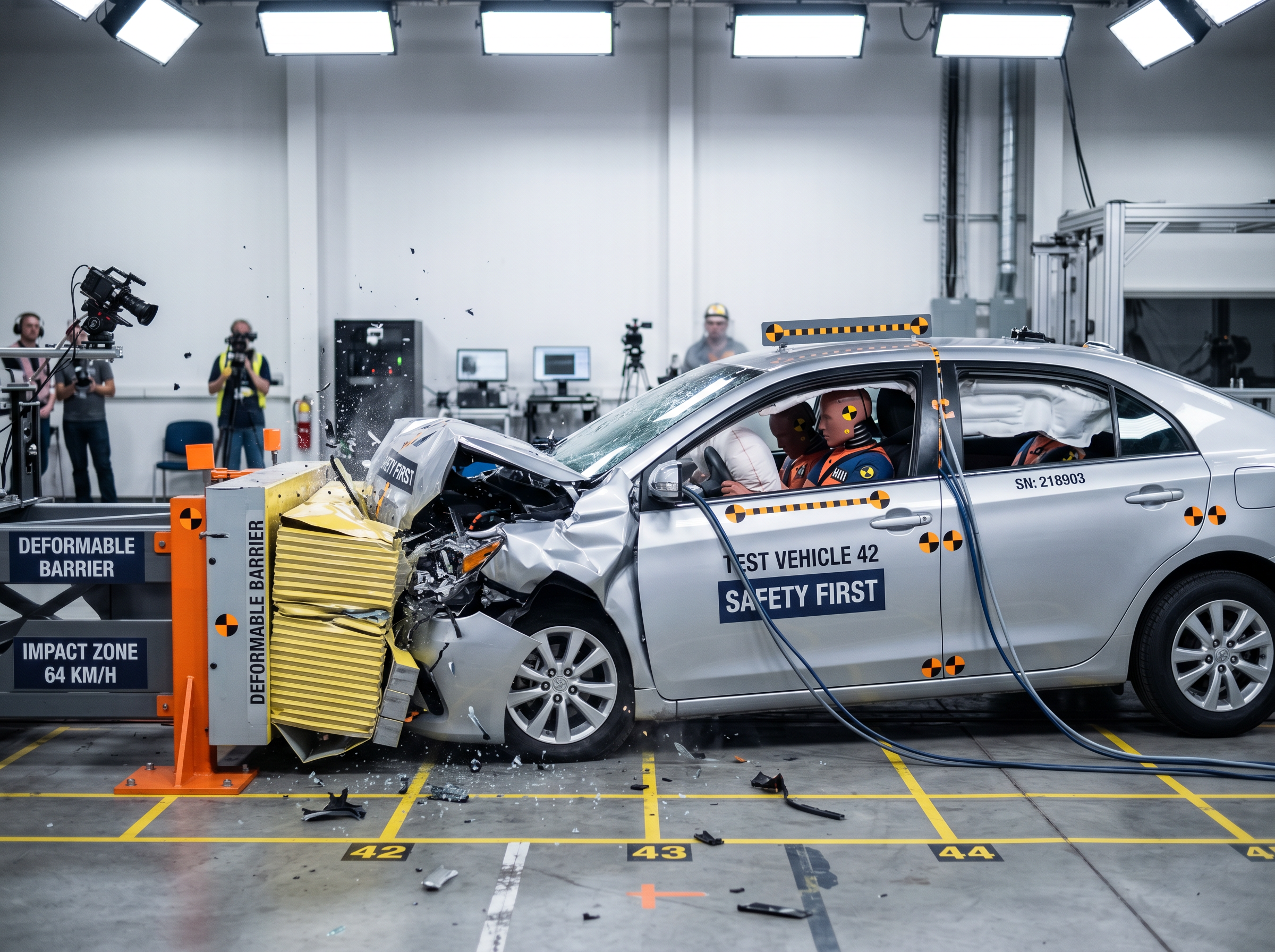
Crash tests from agencies worldwide paint a stark picture. Vehicles hitting barriers at 30 mph (48 kph) often walk away with minor deformation. Double to 60 mph (97 kph), and the front end accordions, airbags deploy violently, and dummies register forces that mimic severe injuries.
In offset crashes or pedestrian impacts, the energy delta is lethal. A car at 30 mph might dent a hood; at 60 mph, it pulverizes. Survival odds plummet: moderate injuries at lower speeds become fatal at double, as KE tears through safety features like candy wrappers.
Think of it this way: Your morning commute at 60 mph packs the punch of a professional boxer's haymaker, while 30 mph feels like a jab.
Pedestrian Safety Speed Limits: Physics Saving Lives on Streets
Nowhere is this clearer than pedestrian safety speed limits. At 30 mph (48 kph), a pedestrian has a 90%+ survival chance if struck—head impact velocity stays survivable. Double to 60 mph? Odds crash below 20%. Why? That quadrupled KE launches bodies like ragdolls, turning sidewalks into danger zones.
Cities enforce 20-30 mph limits in residential areas based on this. In Europe, 30 kph zones (18.6 mph) slash fatalities by 40% or more. Convert: 20 mph = 32 kph ≈ 8.9 m/s, KE a mere quarter of 40 mph speeds.
Practical Example: Urban Crosswalk
Spot a kid chasing a ball at 40 mph (64 kph, 17.9 m/s)? Braking distance: ~80 feet. At 20 mph (32 kph, 8.9 m/s): ~20 feet. Halve speed, slash distance by four—physics hands you the win.
Key Takeaways: Bulletproof Your Driving Habits
- Kinetic energy formula (½mv²) means speed squared dictates crash force—double v, quadruple KE.
- Speed and braking distance scale similarly; always leave more space at higher speeds.
- A 60 mph crash vs 30 mph unleashes 4x the destruction, overwhelming crumple zones.
- Pedestrian safety speed limits like 20-30 mph save lives by capping energy transfer.
- Master speed unit conversion: Use 1.609 for mph to kph to think globally.
- Slow down in uncertainty—your brakes and body will thank you.
The Road Ahead: Drive Smarter, Not Faster
Next time you nudge the pedal past 30 mph, remember: You're not just accelerating; you're arming a bomb where v² is the trigger. This isn't about fear-mongering—it's empowerment. Armed with the kinetic energy formula, speed and braking distance truths, and crash energy physics, you can advocate for safer streets, teach the next generation, or simply arrive alive.
Physics doesn't negotiate. But you can—by easing off the gas. What's your speed story? Share in the comments, and drive safe.