Breaking the Sound Barrier: Mach 1 Explained, Chuck Yeager's Triumph, and Supersonic Speeds of Iconic Aircraft
The Thrill of Defying Sound Itself
Picture this: a sleek rocket plane slices through the dawn sky over California's Mojave Desert. The pilot, ribs aching from a recent horseback riding mishap, grips the controls with unyielding determination. As the speedometer climbs, the aircraft shudders violently, caught in the grip of invisible forces. Then, suddenly—a smooth surge forward. The sound barrier is broken. This wasn't science fiction; it was October 14, 1947, and test pilot Chuck Yeager had just achieved supersonic flight, forever etching his name in aviation history.
For aviation enthusiasts, pilots, and anyone mesmerized by the physics of flight, the story of Mach 1—the Mach number where speed meets the speed of sound—is pure adrenaline. It's not just numbers on a dial; it's the edge where engineering battles nature, where dreams of blistering velocity become reality. In this deep dive, we'll unpack the science behind breaking the sound barrier, relive Yeager's legendary feat, explore the wild aerodynamics at play, and spotlight iconic aircraft that redefined fast. Buckle up—we're accelerating past the sound barrier together.
What Exactly Is Mach 1? Demystifying the Speed of Sound
At its core, the Mach number is a simple ratio: your speed divided by the speed of sound in the surrounding air. Named after Austrian physicist Ernst Mach, Mach 1 means you're flying as fast as sound travels—roughly 767 mph (1,235 km/h) at sea level under standard conditions (59°F or 15°C). But here's the twist that trips up many: Mach 1 isn't a fixed number like 60 mph speed limits. It varies with altitude, temperature, and humidity.
Why? Sound waves propagate through air molecules bumping into each other. Warmer, denser air at sea level lets those molecules hustle faster, pushing the speed of sound higher. Climb to cruising altitudes where it's frigid—say, -50°F—and the speed drops. Think of it like whispering in a crowded, warm room versus a vast, icy stadium: echoes travel quicker in the bustle.
Mach 1 to MPH and KPH: Quick Conversions
For reference, Mach 1 to mph at sea level is about 767 mph, or Mach to kph at 1,235 km/h. But at 36,000 feet, where jets cruise, it's closer to 660 mph (1,060 km/h). We'll break this down in detail later with handy tables.
Chuck Yeager's Daring Triumph: The Day the Barrier Shattered
Before Yeager, pilots feared the sound barrier like a mythical wall. As aircraft neared Mach 1, drag skyrocketed, controls stiffened, and the plane buffeted wildly. Many thought it impossible—hence the "barrier." Enter the Bell X-1, a bullet-shaped rocket plane dropped from a B-29 bomber.
On that fateful morning, Yeager had broken two ribs falling from a horse two days prior. Undeterred, he had a broomstick modified to close the X-1's hatch. Airborne at 43,000 feet, he fired the rockets. The airframe groaned through the transonic zone (Mach 0.8–1.2), where chaos reigns. Then, at 70,000 feet, the needle twitched past 1.06. No wall—just smooth sailing. Yeager's calm voice crackled over radio: "There's no one here to congratulate me." But history was made, paving the way for the jet age.
The Aerodynamic Drama at Mach 1: Shockwaves and Vapor Cones
What makes breaking the sound barrier so treacherous? Enter the transonic regime. As you approach Mach 1, air can't "get out of the way" fast enough. Local airflow speeds hit sonic velocities first—over wings, nose—forming conical shockwaves. These abrupt pressure jumps spike drag by 800%, buffet the plane like a gale, and render control surfaces ineffective as air thickens into a "boundary layer soup."
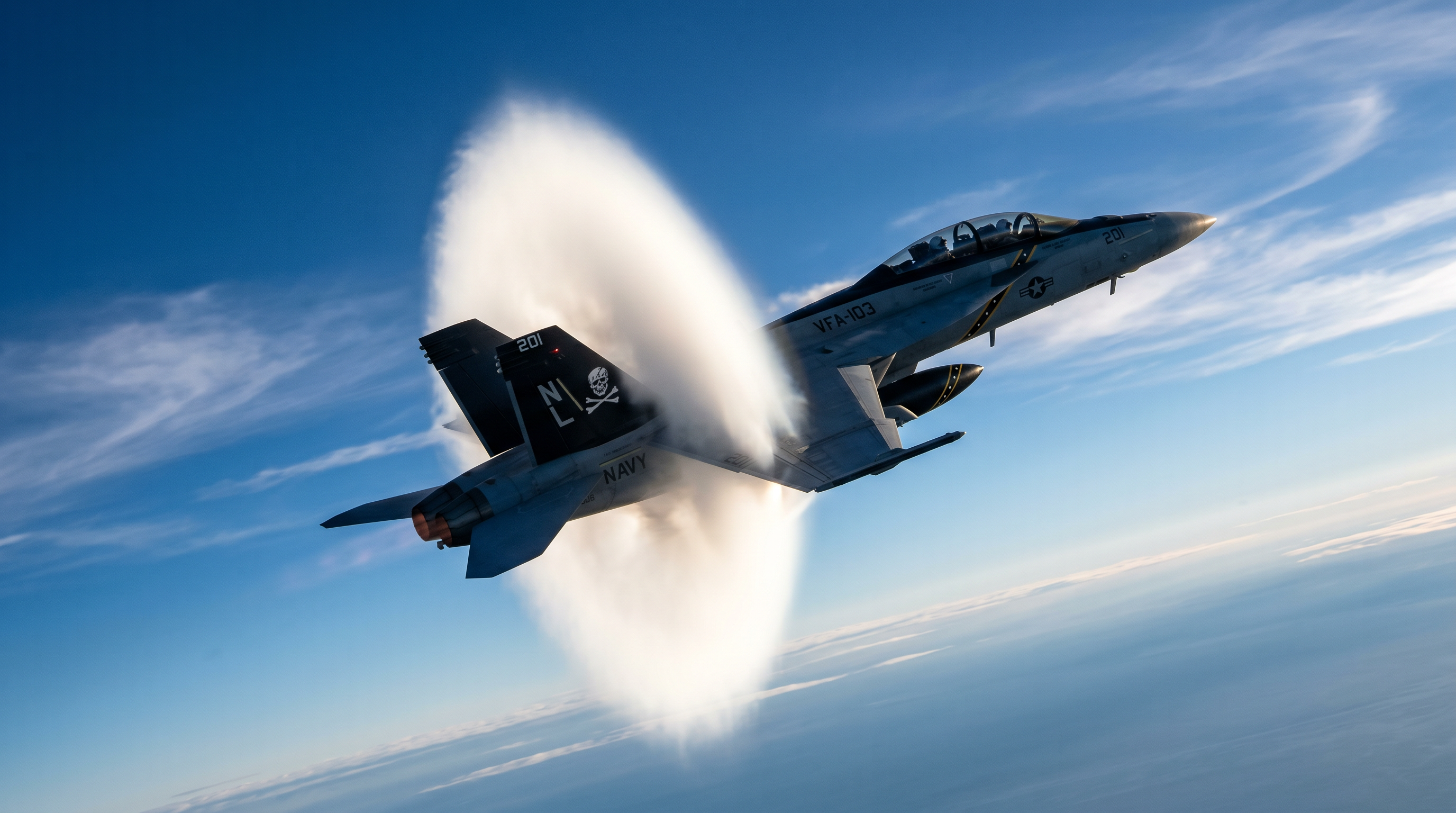
You've seen the vapor cone? That's water vapor condensing around the shockwave in humid air, like a diamond sheath trailing F-16s in demos. Past Mach 1, shockwaves detach, drag plummets (the "sound barrier" illusion), and a sonic boom ripples Earthward—pressure waves coalescing into thunder.
Sweeping wings, area ruling (wasp-waist fuselages), and afterburners cracked the code, turning peril into prowess.
Supersonic Flight vs. Hypersonic: From Mach 1 to the Edge of Space
Supersonic flight kicks in above Mach 1 to 5, where shockwaves stabilize but heat builds (air friction). Hypersonic (Mach 5+) is another beast: temperatures soar to 3,000°F, melting ordinary metals. Vehicles like the X-15 needed ablative coatings and Inconel skins. Today, hypersonics promise globe-circling hops in hours, but reentry plasma and instability challenge engineers.
Iconic Aircraft and Their Blistering Speeds
Dream machines have pushed envelopes ever since. The Concorde speed? A graceful Mach 2.04 (1,354 mph / 2,180 km/h at 60,000 feet), shrinking Paris-NY to 3 hours. The SR-71 Blackbird, CIA spy legend, cruised at Mach 3.3 (2,200+ mph / 3,540 km/h), outrunning missiles with titanium guts.
Modern fighters dazzle: F-22 Raptor hits Mach 2.25 (1,500 mph / 2,410 km/h), supercruise without afterburners. F-35 Lightning II tops Mach 1.6 (1,200 mph / 1,930 km/h). Rocket plane X-15 rocketed to Mach 6.7 (4,520 mph / 7,274 km/h)—the first hypersonic human flight.
- Concorde: Mach 2.04 – Supersonic passenger travel icon.
- SR-71 Blackbird: Mach 3.3 – Untouchable recon speedster.
- F-22 Raptor: Mach 2.25 – Stealth supercruiser.
- F-35: Mach 1.6 – Versatile multirole jet.
- X-15: Mach 6.7 – Hypersonic pioneer.
Mach to MPH and KPH: Conversion Tables by Altitude
Since Mach 1 shifts with conditions, here's approximate Mach to mph and Mach to kph at key altitudes (ISA standard; real values fluctuate ±5%):
| Altitude | Mach 1 (MPH) | Mach 1 (KPH) |
|---|---|---|
| Sea Level (0 ft) | 767 | 1,235 |
| 10,000 ft | 738 | 1,188 |
| 30,000 ft | 663 | 1,067 |
| 50,000 ft | 580 | 934 |
These help pilots gauge true airspeed (TAS) versus indicated. Note: Concorde speed or SR-71 feats shine at high altitudes where true Mach rules.
The Future Beckons: Beyond Mach 1 Lies Adventure
From Yeager's broomstick heroism to Boom Supersonic's Overture promising Mach 1.7 passenger jets, the quest endures. Hypersonics could make Sydney breakfasts routine. Yet the thrill remains: that moment when silence engulfs the cockpit, sound left trailing. For aviation lovers, supersonic flight isn't just speed—it's humanity's roar against the sky. What's your favorite fast flier? The barrier's broken; now we chase the stars.