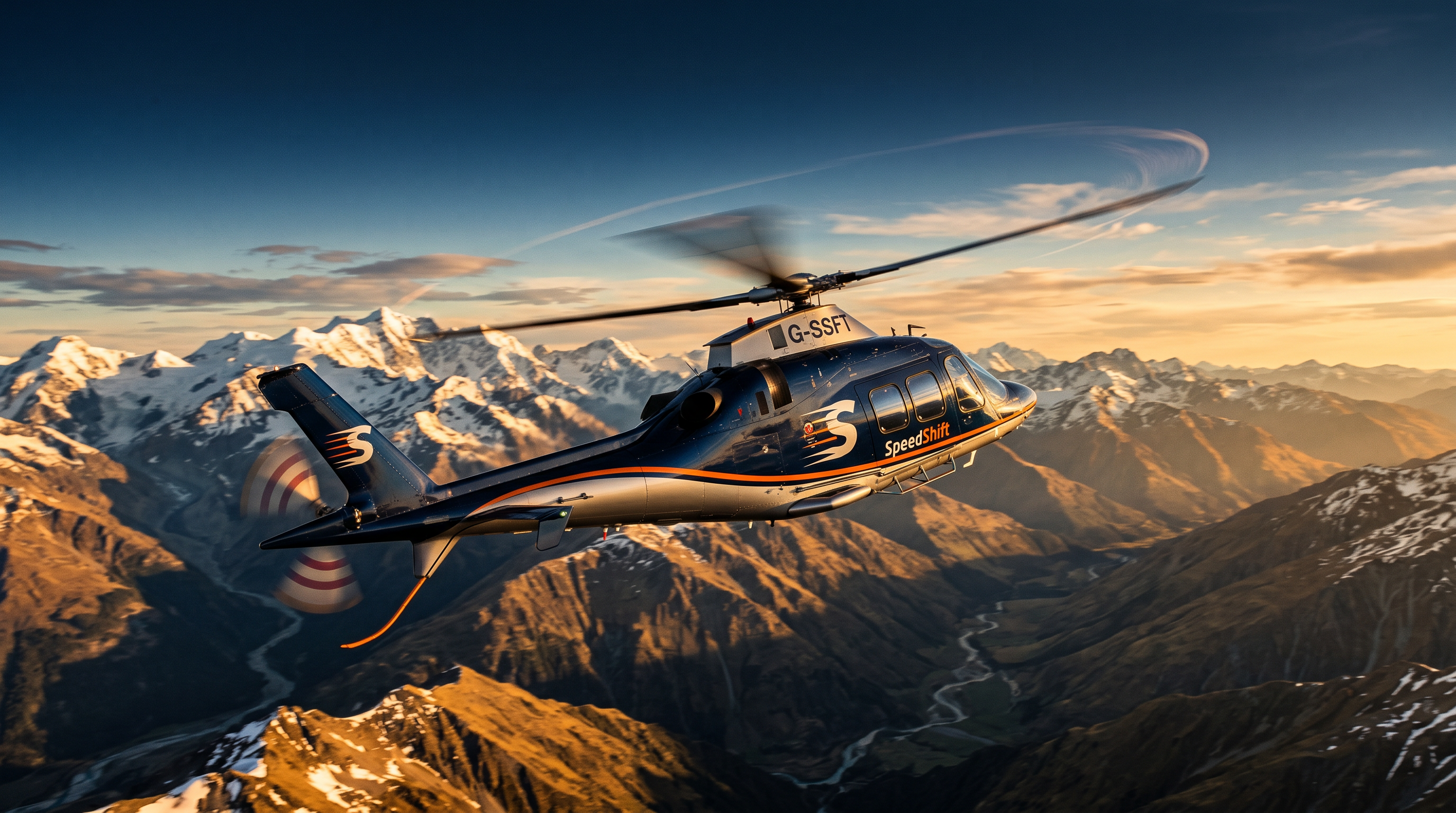
How Fast Do Helicopters Fly? Civilian and Military Helicopter Speeds Compared
Imagine hovering silently above a bustling cityscape, then tilting forward into a surge of speed that defies gravity's grip. Helicopters embody the magic of vertical flight, offering unmatched versatility for rescues, tours, and tactical strikes. But how fast do helicopters fly? It's a question that ignites curiosity among aviation enthusiasts and international travelers alike, blending engineering marvels with the raw thrill of rotor blades slicing the air.
Unlike fixed-wing aircraft that slice through the sky at jet-like velocities, helicopters dance on the edge of physics. Their top speeds hover—pun intended—around 250 MPH (402 KPH, 217 knots), a barrier rooted in aerodynamics. In this deep dive, we'll compare civilian and military helicopter speeds, reveal top models, and decode the units that matter. Whether you're plotting a scenic flight or tracking an Apache in a documentary, understanding helicopter speed unlocks a world of aerial intrigue.
The Physics of Helicopter Speed: Retreating Blade Stall Explained
Helicopters don't just fly; they rotate their way through the atmosphere, with main rotor blades advancing on one side and retreating on the other relative to the direction of travel. This asymmetry births the nemesis of helicopter speed: retreating blade stall.
Picture the rotor disk as a clock face. On the advancing side (say, 12 o'clock), the blade hurtles forward faster than the helicopter's body, gaining lift. But on the retreating side (6 o'clock), it's dragged backward, subtracting speed. At high forward velocities—beyond about 200-250 MPH (322-402 KPH, 174-217 knots)—the retreating blade's relative airspeed plummets below stall threshold. Lift collapses unevenly, rolling the aircraft and demanding heroic piloting to recover.
Engineers combat this with blade design tweaks, higher rotation rates, and auxiliary propulsion, but nature's limit persists for conventional rotors. It's why the quest for the fastest helicopter feels like cracking an aerial code—one vivid reminder that helicopters prioritize hover power over raw velocity.
Units Matter: Mastering KPH to MPH, Knots to MPH Conversions
Aviation speaks in knots (nautical miles per hour), but global travelers toggle between MPH and KPH. One knot equals 1.151 MPH (1.852 KPH). For quick math: multiply knots by 1.151 for MPH, or 1.852 for KPH. Need an aviation speed converter? Tools like SpeedShift deliver instant translations—no mental gymnastics required.
Why care? A Bell 407's 133 knots cruise is 153 MPH (246 KPH)—snappy for sightseeing, but tame against a jet's roar. We'll list all speeds tri-format throughout, empowering your next cockpit chat or travel plan.
Civilian Helicopter Speeds: From Light Trainers to Heavy Lifters
Light Helicopters: Agile and Affordable
Entry-level flyers like the Robinson duo dominate flight schools worldwide.
- Robinson R22: Cruise 96 knots (110 MPH, 178 KPH), Max 110 knots (127 MPH, 204 KPH). Compact trainer, perfect for solo jaunts.
- Robinson R44: Cruise 109 knots (125 MPH, 202 KPH), Max 130 knots (150 MPH, 241 KPH). Four-seater staple for tours; its Robinson R44 speed balances economy and pep.
Medium Twins: Workhorses of the Sky
These mid-sizers haul VIPs and medevac patients with finesse.
- Bell 206 JetRanger: Cruise 122 knots (140 MPH, 226 KPH), Max 140 knots (161 MPH, 259 KPH). Iconic for news cams and joyrides.
- Bell 407: Cruise 133 knots (153 MPH, 246 KPH), Max 161 knots (185 MPH, 298 KPH). Sleek upgrade, pushing civilian limits.
- Airbus H125 (AS350 B3): Cruise 155 knots (178 MPH, 287 KPH), Max 178 knots (205 MPH, 330 KPH). Mountain rescue hero, flirting with stall boundaries.
Heavy Transport: Offshore Giants
- Sikorsky S-92: Cruise 151 knots (174 MPH, 280 KPH), Max 165 knots (190 MPH, 306 KPH). Oil rig shuttle, built for endurance over sprint.
Military Helicopter Speeds: Attack, Transport, and Tactical Edge
Attack Helicopters: Predators of the Battlefield
Armored speed demons prioritize strike velocity.
- AH-64 Apache: Cruise 130 knots (150 MPH, 241 KPH), Max 158 knots (182 MPH, 293 KPH). AH-64 Apache speed enables Hellfire runs at tree-top level.
- AH-1 Cobra: Cruise 120 knots (138 MPH, 222 KPH), Max 170 knots (196 MPH, 315 KPH). Vietnam vet, still slithering fast.
Transport Helicopters: Heavy Haulers with Surprising Pace
Troop movers trade some speed for payload, yet outliers shine.
- UH-60 Black Hawk: Cruise 159 knots (183 MPH, 295 KPH), Max 183 knots (211 MPH, 339 KPH). Special ops icon, slicing through hot zones.
- CH-47 Chinook: Cruise 120 knots (138 MPH, 222 KPH), Max 170 knots (196 MPH, 315 KPH). Tandem rotors minimize retreating blade woes, explaining its brawny CH-47 Chinook speed despite 50-foot span and 50-troop capacity—downwash symmetry lets it hustle.
Breaking the Wall: The Fastest Helicopters Ever Built
Records shatter limits. In 1986, the Westland Lynx scorched to 216.45 knots (249.09 MPH, 400.87 KPH)—the fastest helicopter production mark, aided by a slim fuselage and fierce tail rotor.
Experimental beasts push further:
- Sikorsky X2: Demonstrated 250 knots (287 MPH, 463 KPH) in 2010 via coaxial rotors and pusher prop—co-rotation cancels dissymmetry.
- Eurocopter X3 (now Airbus): Hit 293 knots (337 MPH, 543 KPH) in 2013, stiff wing with wingtip props sidestepping stall entirely.
These hybrids hint at compound helicopter futures, where rotors lift but props propel.
Airspeed vs. Ground Speed: How Pilots Calculate True Velocity
Airspeed (relative to air mass) differs from ground speed (over terrain). Headwinds shave 20 knots off a Black Hawk's dash; tailwinds add thrill. Pilots blend pitot-static gauges, GPS, and Doppler radar for precision—essential for low-level ops where a knot separates success from scrape.
In turbulence, indicated airspeed rules; for ETAs, ground speed dominates. It's the pilot's art, turning data into destiny.
Civilian vs. Military: Trade-Offs in Speed, Durability, and Cost
Civilians chase efficiency: light frames yield 150-180 MPH (241-290 KPH) cruises at $500/hour. Military birds armor up—Apaches shrug .50-cal hits but guzzle fuel at triple cost, speeds honed for survival dashes.
Durability trumps pace in combat; civilians prioritize comfort. Yet overlaps exist: H125s match Black Hawk cruises, proving civilian tech's edge.
The Evolution of Helicopter Speed: Hover to Horizon
From Igor Sikorsky's 1910 clunker to X3 hybrids, helicopter speed has tripled, battling physics with ingenuity. Civilian fleets ferry dreamers; military ones guard nations. Next time you hear rotors thrum, recall: it's not just flight—it's defiance.
For instant KPH to MPH conversion, knots to MPH, or any helicopter speed check, fire up SpeedShift. Your aerial adventures await—faster than ever.