Supersonic Passenger Travel Revival: Concorde's Mach 2 Legacy to Boom Overture's Future
The Dawn of Supersonic Flight: Concorde's Unmatched Legacy
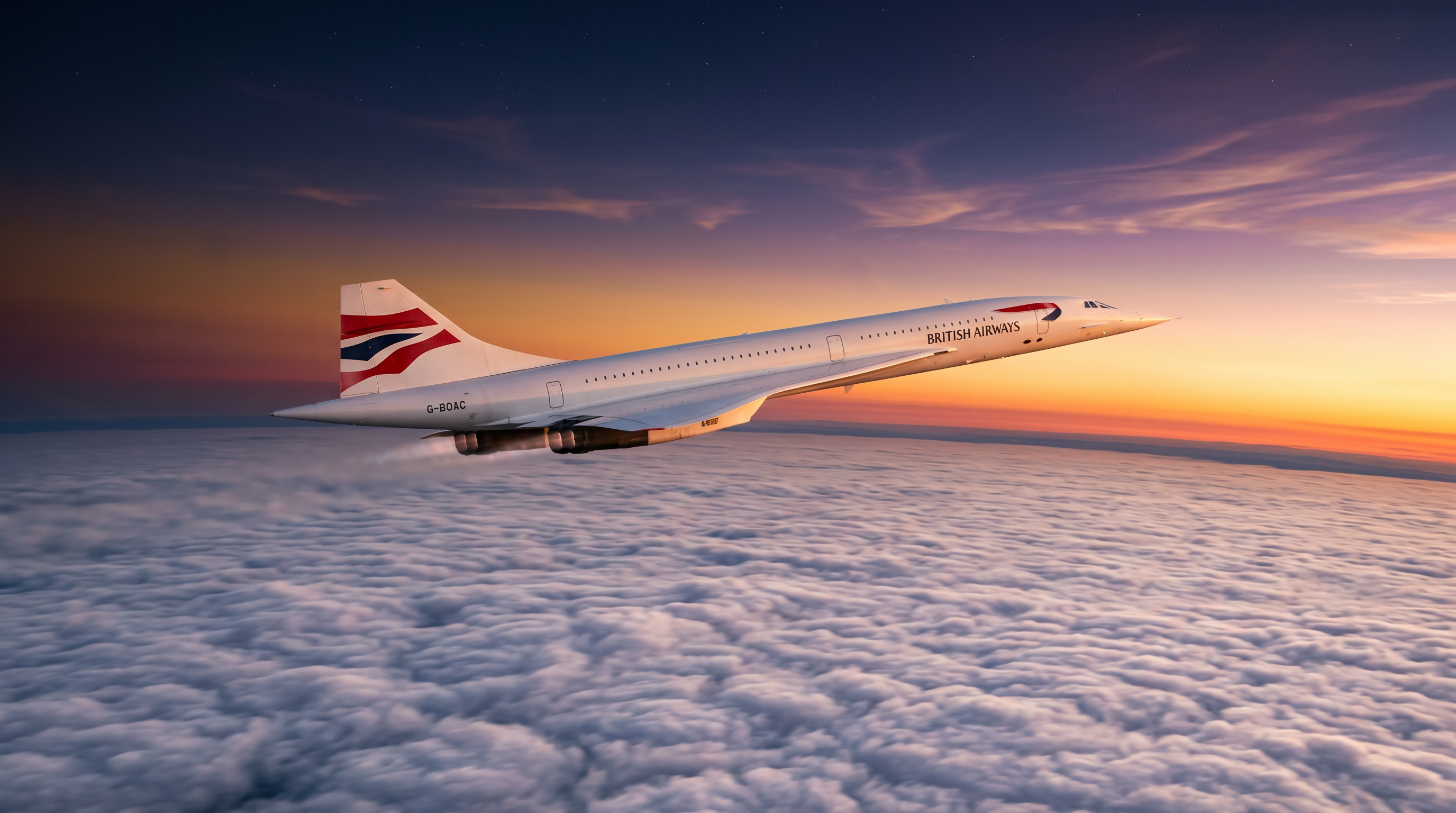
Picture this: You're strapped into a sleek Anglo-French marvel, engines thundering as the Concorde jet speed surges past sound's barrier. In mere hours, continents shrink beneath you. This wasn't science fiction—it was the reality of supersonic passenger travel from 1976 to 2003. The Concorde, a delta-winged icon, redefined aviation engineering, cruising at Mach 2.04, or roughly 1,354 mph (2,179 kph, 1,176 knots). For aviation buffs and business travelers, it promised a world where time zones bent to human will.
Supersonic flight history began with military experiments, but Concorde brought it to civilians. Jointly developed by Britain and France, only 20 entered service, ferrying elites across the Atlantic in under three-and-a-half hours. New York to London? Just 2 hours and 52 minutes on its fastest run. That blistering pace wasn't just numbers; it was a sensory rush, the horizon curving visibly through tiny porthole windows designed to withstand extreme pressures.
Concorde Jet Speed: Decoding Mach 2.04
Mach 2.04 meant twice the speed of sound—about 1,354 miles per hour at altitude. For context, a standard Boeing 747 plods along at 565 mph. Concorde's afterburning Olympus engines propelled it to 60,000 feet, where thinner air reduced drag. Passengers felt the boom of sonic transition, a gentle shudder as the aircraft pierced the sound barrier over water, respecting land bans on shockwaves.
Aboard the Concorde: An Unforgettable Passenger Experience
Step inside, and luxury met velocity. Crystal glassware clinked amid 100 seats in a cabin narrower than today's widebodies. Those small windows—about half the size of conventional jets—framed a cockpit view: the black of space edging the blue planet's curve. Travelers sipped champagne as Earth rotated visibly below, a perk of altitude and speed no subsonic flight could match.
Business travelers cherished the efficiency; a London boardroom meeting wrapped before lunch in Manhattan. Yet, it demanded adaptation: higher cabin pressure fought jet lag, but the ride was smoother aloft than takeoff's roar. Nostalgia lingers in tales of supersonic sunrises, chasing dawn across oceans.
The Fall of Concorde: High Costs, Noise, and a Tragic Turn
Why did this pinnacle of supersonic passenger travel retire? Economics bit hardest. Tickets cost $12,000 round-trip—eight times a first-class Concorde alternative. Fuel thirst was voracious; at Mach 2, it guzzled four times more per passenger than a 747. The 1973 oil crisis slashed viability, and noise complaints grounded it over landmasses.
Then, Air France Flight 4590 crashed in 2000, killing 113 due to tire debris rupture. Post-9/11 slumps sealed the fate; the fleet retired in 2003. Concorde's end felt like losing a comet—brilliant, but unsustainable in a world prioritizing green aviation.
- Fuel inefficiency: 17 gallons per passenger per 100 miles.
- Boom restrictions: Sonic booms banned over populated areas.
- Maintenance costs: Exotic materials like aluminum-copper alloys aged expensively.
Speed Context: Why Precision in Units Matters for Pilots and Travelers
In aviation engineering, speed isn't casual chatter. Pilots demand precision—Mach for compressibility effects, knots for navigation, mph for public appeal. Enter Speed Context: At sea level, Mach 1 is 761 mph (661 knots, 1,225 kph). But at 50,000 feet, it's 660 mph due to colder air.
Instant Speed Conversion: Mach to Knots and Beyond
Concorde's Mach 2.04? Instant Speed Conversion: 1,354 mph, 2,179 kph, or 1,176 knots. Why knots? Nautical miles (6,076 feet) suit aviation's oceanic roots; 1 knot = 1 nautical mile per hour. For business travelers plotting routes, this clarity prevents errors—mix-ups in a storm spell disaster. Modern apps deliver real-time conversions, but understanding grounds the thrill: Supersonic means reclaiming hours, turning Paris to New York into a workday whim.
"Speed is the currency of the skies—convert it right, and the world shrinks."
The Renaissance: Boom Supersonic Overture Takes Flight
Supersonic passenger travel rises anew. Boom Supersonic's Boom Supersonic Overture targets Mach 1.7—1,122 mph (975 knots)—halving New York-London to 3.5 hours. Seating 64-80 in sustainable fuels, it promises Concorde elegance minus the excess. Orders from United Airlines signal demand; first flight eyes 2027, service by 2029.
Spike Aerospace's S-512 eyes Mach 1.6 with no-boom design via unique shaping. Meanwhile, NASA's X-59 QueSST pioneers quiet supersonic tech, shaping nose waves to soften booms to a "thump." Aviation engineering evolves: Composites cut weight, electric aids efficiency, AI optimizes routes.
- Overture: 100 seats, 4,250 nm range, $200M per jet.
- S-512: Business jet focus, panoramic views sans windows.
- X-59: Tests over U.S. cities to lift FAA bans.
Overcoming Hurdles: Aviation Engineering's Next Frontier
Challenges persist. Sonic booms demand redesigns; Overture flies subsonic over land. Sustainable aviation fuel (SAF) is key—Boom pledges net-zero carbon. Regulations loom: FAA/EASA eye new noise standards. Yet, excitement builds; Hermeus and Venus Aerospace chase hypersonic dreams beyond Mach 5.
The Future Horizon: Economics, Regulations, and Supersonic Dreams
Will economics favor this revival? Fares may start at $5,000, premium but accessible for business travelers. Regulations evolve; X-59 data could greenlight overland flights, exploding routes like Tokyo-Sydney. Imagine: Transpacific meetings in half-days, tourism unbound.
Concorde's ghost whispers promise. Supersonic skies beckon—not as relic, but renaissance. For aviation buffs, it's vindication; for travelers, time's conquest. Strap in—the boom returns, quieter, greener, faster.