Top 10 Fastest Fighter Jets in Service: Mach to MPH Conversions, Supercruise Breakdowns & Speed Rankings
The Thrill of Supersonic Skies: Why Speed Still Rules Air Superiority
Picture this: a sleek predator slices through the stratosphere at twice the speed of sound, leaving a thunderous sonic boom in its wake. The air compresses violently ahead of its nose, forming shockwaves that ripple like invisible tsunamis. This is supersonic flight—the realm where fighter jets transcend mere aircraft to become hypersonic harbingers of dominance. But in an era of stealth cloaks and beyond-visual-range missiles, does raw speed still matter?
Absolutely. While 5th-generation stealth fighters like the F-35 prioritize invisibility, speed remains the ultimate arbiter in contested skies. It enables rapid intercepts of bombers and cruise missiles, quick dashes to evade surface-to-air threats, and the kinetic energy to outrun incoming fire. Aviation physics dictates that crossing Mach 1 unleashes a drag explosion in the transonic regime (Mach 0.8-1.2), but mastering it unlocks supercruise and stratospheric supremacy. Today, we rank the fastest fighter jets still in active service, complete with Mach to MPH conversions using our Instant Speed Conversion for precision (based on standard sea-level Mach 1 ≈ 767 MPH / 1,235 KPH / 666 knots).
Top 10 Fastest Fighter Jets: Rankings, Origins, and Performance Breakdowns
From Cold War relics evolved into modern guardians to cutting-edge air dominance machines, these jets push aerodynamic limits. Each entry details origin, primary role, and a speed table for instant comparisons in the global fighter jet ranking.
1. Mikoyan MiG-31 Foxhound (Russia)
Born in the late 1970s as a high-altitude interceptor to counter US B-1 bombers, the MiG-31 remains Russia's zenith of speed. With four AL-31F engines and a massive radar, it hunts low-flying cruise missiles at extreme velocities. Still patrolling Arctic frontiers, it's the undisputed speed king among active fighters.
| Metric | Value |
|---|---|
| Mach | 2.83 |
| MPH | 2,171 |
| KPH | 3,495 |
| Knots (Kn) | 1,887 |
2. McDonnell Douglas F-15 Eagle (USA)
Entering service in 1976, the F-15 has an undefeated air-to-air record. Evolved into F-15EX variants, it blends supersonic speed with multirole versatility—air superiority, strikes, and intercepts. Twin Pratt & Whitney F100 engines propel it to blistering dashes.
| Metric | Value |
|---|---|
| Mach | 2.5 |
| MPH | 1,918 |
| KPH | 3,088 |
| Knots (Kn) | 1,665 |
3. Sukhoi Su-27 Flanker (Russia/China/Others)
Debuting in 1985, the Su-27 revolutionized air combat with supermaneuverability and reach. As the backbone of Russian and exported fleets (e.g., China's J-11), it excels in long-range intercepts and dogfights, powered by AL-31F turbofans.
| Metric | Value |
|---|---|
| Mach | 2.35 |
| MPH | 1,802 |
| KPH | 2,902 |
| Knots (Kn) | 1,566 |
4. Mikoyan MiG-29 Fulcrum (Russia/India/Others)
The 1980s counterpart to the F-16, the MiG-29 offers rugged, high-agility performance for close air support and superiority. Upgraded variants serve worldwide, its RD-33 engines enabling rapid climbs and supersonic speed bursts.
| Metric | Value |
|---|---|
| Mach | 2.25 |
| MPH | 1,726 |
| KPH | 2,779 |
| Knots (Kn) | 1,500 |
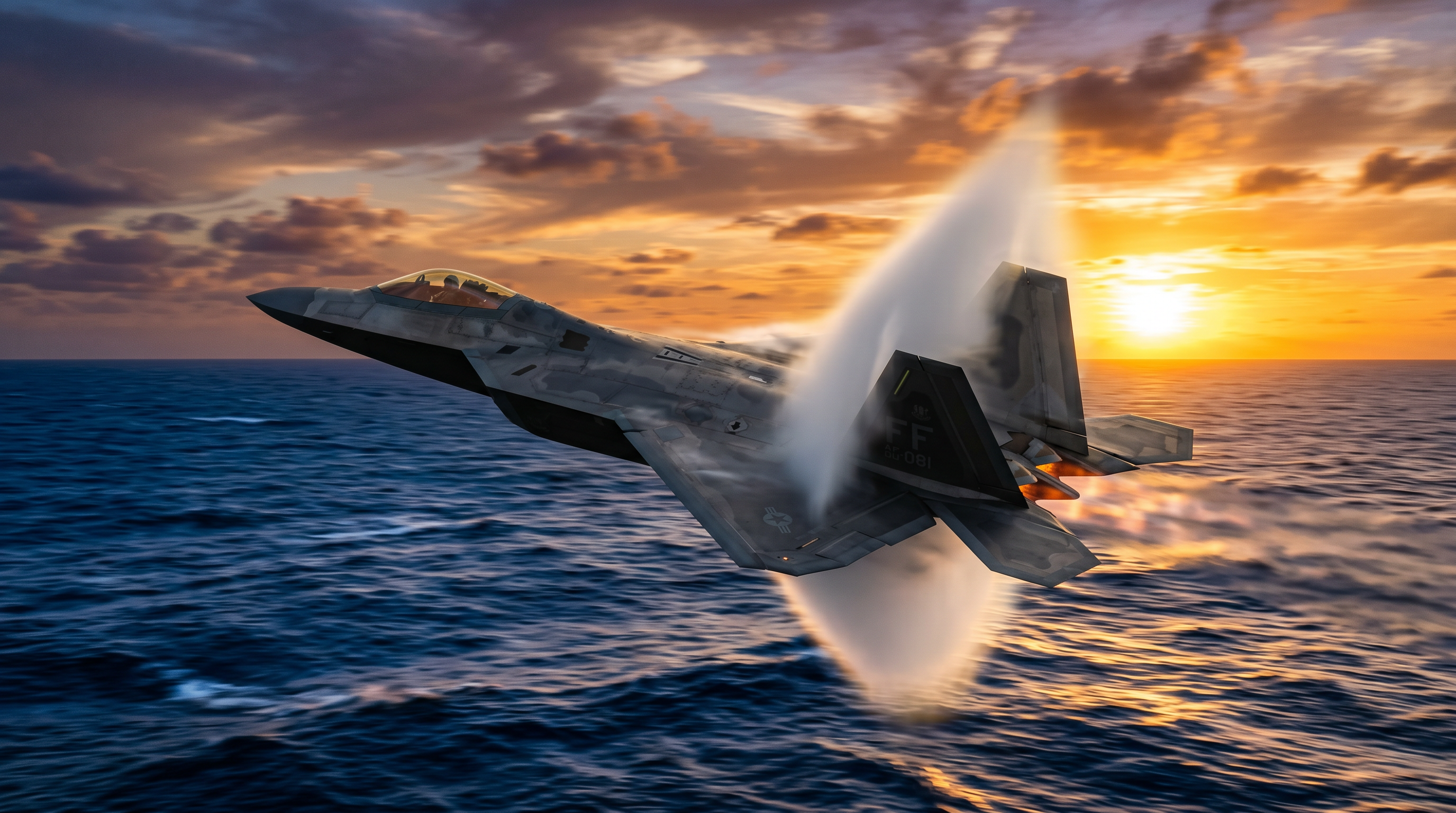
5. Lockheed Martin F-22 Raptor (USA)
The pinnacle of 5th-gen stealth, operational since 2005. Thrust-vectoring F119 engines grant unmatched agility and the first operational supercruise, balancing stealth vs speed in air dominance roles.
| Metric | Value |
|---|---|
| Mach | 2.25 |
| MPH | 1,726 |
| KPH | 2,779 |
| Knots (Kn) | 1,500 |
6. Sukhoi Su-35 Flanker-E (Russia)
A 4.5-gen evolution of the Su-27, introduced in 2014. Irbis-E radar and supermaneuverability make it a peerless multirole platform, sustaining high speeds for extended patrols.
| Metric | Value |
|---|---|
| Mach | 2.25 |
| MPH | 1,726 |
| KPH | 2,779 |
| Knots (Kn) | 1,500 |
7. Dassault Mirage 2000 (France/India/Others)
Since 1984, this delta-wing icon delivers precision strikes and intercepts. Upgraded -5/9 variants keep it viable, with SNECMA M53 engines for agile supersonic speed.
| Metric | Value |
|---|---|
| Mach | 2.2 |
| MPH | 1,687 |
| KPH | 2,715 |
| Knots (Kn) | 1,465 |
8. Eurofighter Typhoon (Europe)
Operational from 2003, this trinational marvel fuses supercruise capability with AESA radar for all-weather supremacy. EJ200 engines enable sustained Mach 1.5+ without afterburners.
| Metric | Value |
|---|---|
| Mach | 2.0 |
| MPH | 1,534 |
| KPH | 2,470 |
| Knots (Kn) | 1,332 |
9. Sukhoi Su-57 Felon (Russia)
Russia's stealthy 5th-gen entrant, flying since 2010. AL-41F1 engines promise supercruise at Mach 1.6+, with thrust vectoring for extreme maneuvers in contested airspace.
| Metric | Value |
|---|---|
| Mach | 2.0 |
| MPH | 1,534 |
| KPH | 2,470 |
| Knots (Kn) | 1,332 |
10. Saab JAS 39 Gripen (Sweden)
Since 1996, this lightweight multirole fighter punches above its weight with Volvo RM12 engines. Affordable and versatile, it sustains high speeds for rapid response missions.
| Metric | Value |
|---|---|
| Mach | 2.0 |
| MPH | 1,534 |
| KPH | 2,470 |
| Knots (Kn) | 1,332 |
Supercruise: Sustained Supersonic Without the Burn
Afterburners guzzle fuel like a sports car at full throttle, limiting supersonic dashes to minutes. Supercruise—holding Mach 1+ dry—revolutionizes tactics. The F-22 achieves Mach 1.82 without reheat, slashing infrared signature and extending range. The Su-57 and Typhoon claim similar feats, powered by high-bypass fans and optimized inlets. This aviation physics edge lets pilots engage, evade, and dominate without the heat penalty.
Stealth vs Speed: The Aerodynamic Trade-Off
Low-observable designs crave smooth curves and edges to deflect radar, but these snag airflow at Mach 2+. Serrated nozzles and canted tails boost stealth yet hike drag. F-22 and Su-57 navigate this via variable geometry and materials, proving stealth vs speed isn't zero-sum—yet it caps top ends below 1960s speed demons.
The Speed Paradox: Slower Than the MiG-25?
The MiG-25 hit Mach 3.2 in 1967, yet modern jets top out lower. Why? Multirole demands—maneuverability, payload, avionics—trump pure intercept speed. Stealth mandates sub-Mach 2.5 norms to avoid radar blooming.
Heat and Friction: The Mach 3 Thermal Thicket
At Mach speed conversion extremes, air molecules slam the airframe, generating kinetic heating. Mach 2: 200°C skin temps; Mach 3: 1,000°C+, melting aluminum. Ti alloys and ceramics fight back, but fuel boils and radar domes warp. This 'thermal thicket' stalls fighters at Mach 2.5-3, reserved for specialist recon like the SR-71.
The Hypersonic Horizon: Future of Fighter Speed
As drones swarm and lasers gleam, hypersonic fighters loom. Scramjet tech promises Mach 5+ strikes, but integration challenges persist. NGAD and Tempest programs hint at blended-wing speedsters fusing AI, lasers, and Mach 2+ supercruise. Speed evolves, but these top 10 fastest fighter jets remind us: in the wild blue, velocity is eternal.