MPH to KPH: Ultimate Speed Conversion Guide for Safe Driving Abroad
Picture this: You're an American tourist, fresh off the plane in Paris, sliding behind the wheel of a sleek rental Peugeot. The open road beckons through the Loire Valley's vine-draped hills. A sign flashes by—130. Your gut screams "highway speed," but is that 130 miles per hour? Heart pounding, you ease off the gas, only to crawl behind frustrated locals. Sound familiar? For international travelers renting cars abroad, mph to kph confusion isn't just embarrassing—it's a fast track to fines, stress, or worse. This ultimate guide arms you with everything for speed limit conversion, safe driving abroad, and mastering miles per hour to kilometers per hour.
Whether you're a U.S. road-tripper hitting Europe's autobahns, a Brit navigating American interstates, or an Aussie tackling U.K. motorways, getting your speed unit conversion right keeps the adventure rolling smoothly. Let's dive in.
Speed Units Around the World: MPH Countries vs. KPH Nations
The world splits neatly into two camps for road speeds: miles per hour (MPH) holdouts and kilometers per hour (KPH) dominators. Knowing which is which—and their typical limits—prevents that deer-in-headlights moment at every signpost.
MPH Strongholds: USA and UK
In the United States, MPH reigns supreme. Urban streets cap at 25-35 mph, suburbs hit 40-45 mph, and interstates soar to 65-75 mph in states like Texas or Utah. Watch for school zones dropping to 20 mph.
The UK sticks to MPH too, with imperial roots intact. Towns enforce 30 mph, national speed limits on single carriageways are 60 mph, and motorways top out at 70 mph. Dual carriageways often allow 70 mph—easy to blast past if you're converting on the fly.
KPH Everywhere Else: Europe, Canada, Australia, and Beyond
Most of the globe runs on metric KPH. In continental Europe, cities like Berlin or Madrid hold 50 kph, rural roads 90-100 kph, and highways 120-130 kph (Germany's Autobahn has no posted limit in spots, but 130 kph is advised). France mirrors this: 50 kph urban, 130 kph autoroutes.
Canada blends in at 50 kph city, 100 kph highways. Australia's urban 50 kph jumps to 100-110 kph on motorways. Japan keeps it tight: 40-60 kph urban, 100 kph expressways. Even metric holdouts like Mexico (60 kph city, 110 kph highway) follow suit.
- Pro Tip: Always check your rental car's GPS or app like Waze for local limits—they often display in the host country's units.
Reading Foreign Speedometers: What to Spot in Your Rental
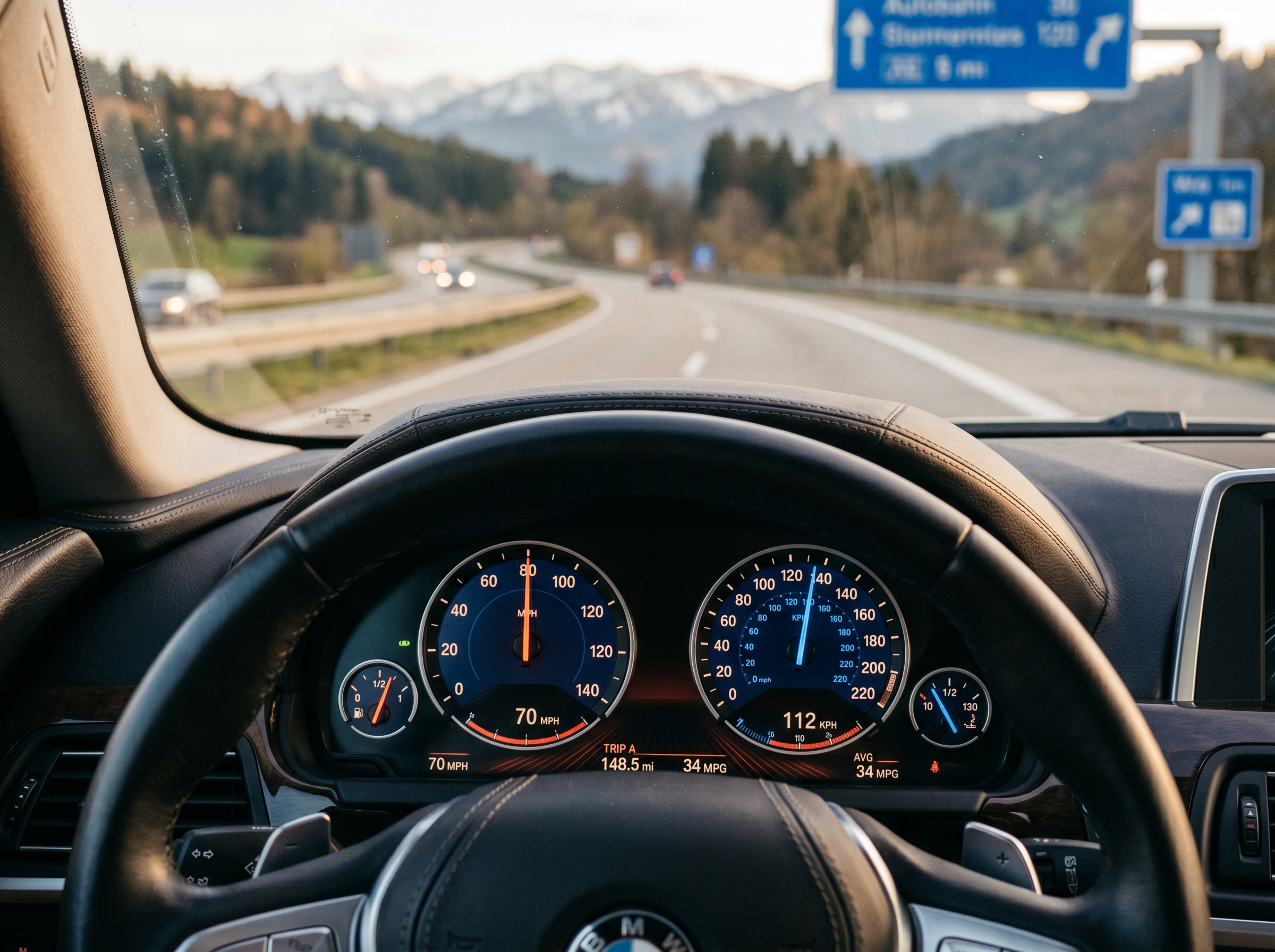
Renting abroad? Foreign speedometers can trick the eye. Analog dials might arc with MPH outer markings and KPH inner rings—look closely. Digital displays often toggle units via a button (check the manual or dashboard icons like "km/h" vs "mph").
Tourist-friendly rentals in Europe or Australia frequently feature dual-display gauges: MPH and KPH side-by-side. In the U.S., KPH lurks in small print on the inner scale. Pro move: Snap a photo of your dash pre-drive. If it's analog-only in alien units, rely on mental math or a sticky-note cheat sheet.
Electric rentals? Apps like Tesla's interface let you switch units globally—set it to your home preference for sanity.
MPH to KPH Conversions: Mental Math Tricks for the Road
No calculator mid-merge? The golden rule: Multiply MPH by 1.6 for KPH (or divide KPH by 1.6 for MPH). It's approximate but spot-on for most signs.
Exact Formulas
MPH to KPH: KPH = MPH × 1.60934
KPH to MPH: MPH = KPH ÷ 1.60934 (or × 0.621371)
Quick hack: 8/5 rule (MPH × 8 ÷ 5 = KPH)
Street-smart shortcuts:
- 30 mph ≈ 50 kph (perfect for town limits)
- 60 mph ≈ 100 kph (highway sweet spot)
- 70 mph ≈ 110 kph (U.S. interstate to Euro autoroute)
- 50 mph ≈ 80 kph
- 100 kph ≈ 62 mph (flip it for Canada/Aussie roads)
Practice: 55 mph? 55 × 1.6 = 88 kph. Glance at a 90 kph sign—close enough to cruise confidently.
| MPH | KPH |
|---|---|
| 20 | 32 |
| 30 | 48 |
| 40 | 64 |
| 50 | 80 |
| 60 | 97 |
| 70 | 113 |
| 80 | 129 |
| 100 | 161 |
Real-World Scenarios: From American in Germany to Aussie in the USA
Let's play it out. You're a New Yorker flooring it on Germany's Autobahn. Signs scream 130 kph—you multiply 130 ÷ 1.6 ≈ 81 mph. Feels right; locals zip by at 140 kph (87 mph). No sweat.
Flip it: A Parisian in California. Interstate sign: 65 mph. 65 × 1.6 = 104 kph—faster than France's 130? Nah, settle in; it's the flow.
Brit in Australia: Motorway 110 kph ÷ 1.6 ≈ 69 mph, matching U.K. 70. Aussie Down Under in Texas: 75 mph highway × 1.6 = 120 kph—familiar turf.
Urban twist: Canadian in London—30 mph town limit ≈ 48 kph. Easy does it past red phone booths.
Safety First: The Real Risks of Speed Unit Mix-Ups
🚨 Speed Conversion Saves Lives
Misreading a 50 kph zone as 50 mph? That's 80 kph over—flying through neighborhoods. Fines stack up (€100+ in Europe), but tailgating trucks or school buses? That's catastrophe. Unit confusion fuels speeding tickets for 1 in 5 rental drivers abroad. Stay sharp: Wrong speed kills the vibe—and worse.
Beyond fines (up to $500 in the U.S., €750 in Spain), it spikes accident risk. Overtake too slow on highways, or blast residential zones—both dicey. GPS alerts help, but your brain's the best navigator. Print this guide; knowledge is your airbag.
Your International Driving Guide: Final Takeaways
Mastering mph to kph transforms driving abroad from white-knuckle to wind-in-hair joy. Bookmark the table, tattoo the 1.6 rule, inspect that speedo. Next time a 100 kph sign looms, grin—you're dialed in. Safe travels; the world's roads await.