Hyperloop and the Future: Speeds That Could Change Travel Forever
The Dawn of a New Era in Speed
Picture this: you're sipping coffee in Los Angeles at dawn, and by the time the sun crests the Sierra Nevada, you're strolling through San Francisco's bustling streets—door to door in under 35 minutes. No security lines, no turbulence, just seamless acceleration to Hyperloop speeds of 760 MPH (1,223 KPH). This isn't science fiction; it's the promise of Hyperloop, the proposed 'fifth mode' of transportation, following in the hoofbeats of walking, horseback, rail, and air travel.
Humanity's obsession with speed has reshaped the world. Horses topped out at 40 MPH bursts; steam trains pushed 100 MPH in the 1930s; jets shattered 500 MPH barriers post-WWII. Now, Hyperloop envisions vacuum travel and magnetic levitation converging to redefine future transport. Conceived in Elon Musk's 2013 whitepaper, it's not just faster—it's a revolution in efficiency, slashing energy use and emissions while compressing distances like never before.
What is Hyperloop? Pods in Low-Pressure Tubes
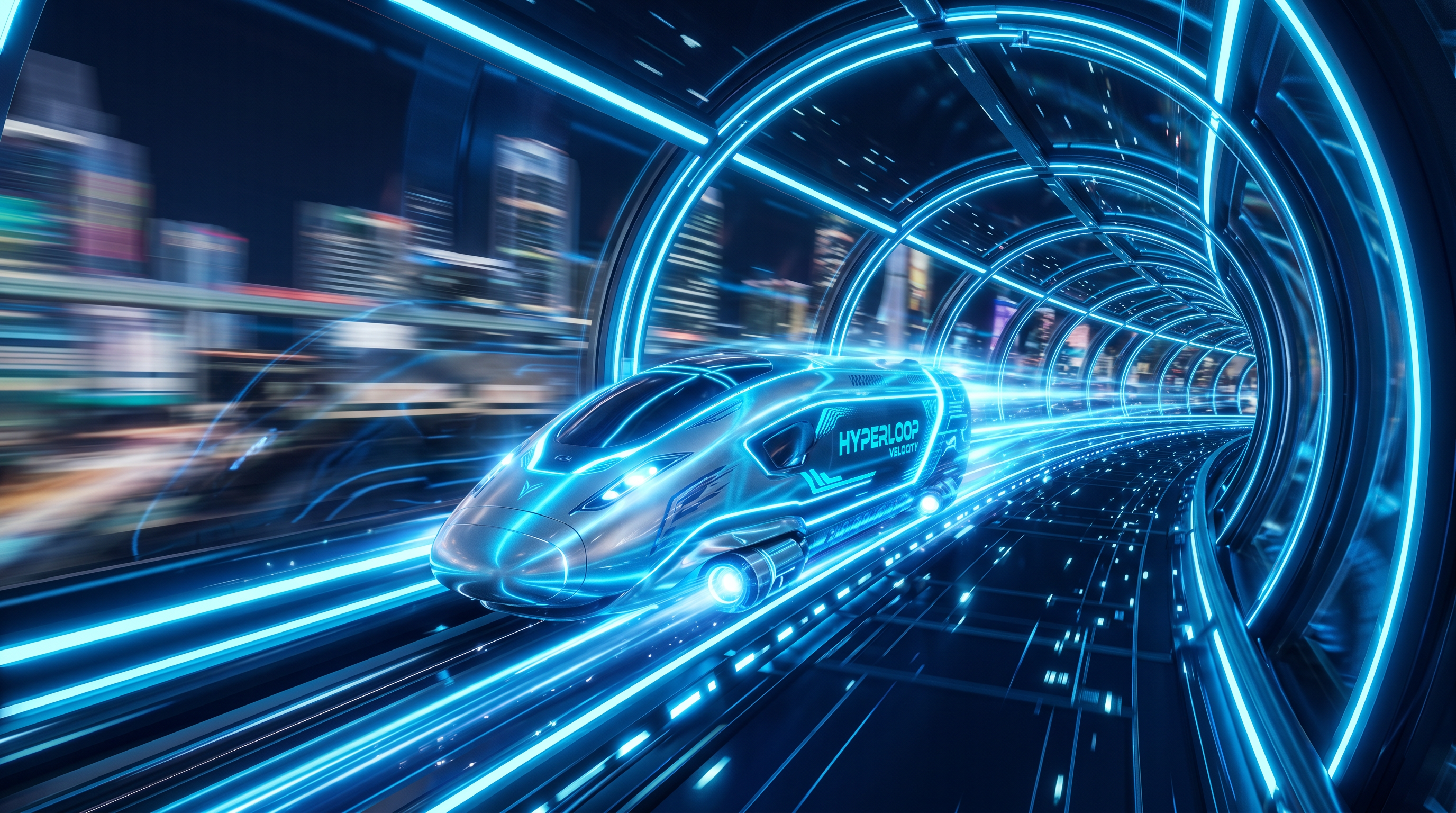
At its core, Hyperloop is a network of sealed tubes where passenger or cargo pods glide at airline speeds on the ground. These low-pressure tubes—nearly a vacuum—house streamlined pods propelled by linear electric motors, hovering inches above the track via magnetic levitation. No wheels touch the 'road'; instead, powerful magnets provide frictionless support and thrust.
Imagine boarding a sleek, autonomous pod for 20-30 passengers, complete with wide seats and panoramic views through transparent sections. The tube shields you from weather, noise, and wind, creating a cocoon of calm amid blistering velocity. This fusion of train, plane, and subway tech promises Hyperloop speeds that make today's high-speed rail feel pedestrian.
The Physics of Near-Vacuum Travel: Conquering Air Resistance
Why Air is Speed's Greatest Enemy
Physics dictates that air resistance, or drag, scales quadratically with speed—double your velocity, and drag quadruples. At 760 MPH, conventional trains or cars would melt from friction heat alone. Air molecules battering the vehicle create immense opposing force, demanding exponentially more energy.
Enter vacuum travel: by evacuating 99% of the air from the tube (down to 100 Pascals, vs. sea-level's 101,000), Hyperloop slashes drag to a whisper. Pods encounter molecules as rarely as a jet at 100,000 feet altitude. This near-vacuum environment unlocks future transport potential, allowing sustained Hyperloop speeds with minimal energy—about one-tenth that of a plane per passenger mile.
Energy Efficiency in a Bottle
The result? Acceleration feels gentle, like a luxury elevator, peaking at 1G before cruising. Tools like SpeedShift Converter's instant speed conversion help grasp this: convert 760 MPH to 1,223 KPH effortlessly, providing speed context against everyday benchmarks. Suddenly, LA to SF shrinks from a six-hour drive to half an hour.
Magnetic Levitation (Maglev): Frictionless Flight on Rails
Wheels and rails introduce friction, capping speeds around 200 MPH before wear and heat dominate. Magnetic levitation, or maglev, eliminates this entirely. Superconducting magnets on the pod induce opposing fields in the track, levitating the vehicle 1-2 cm above. Propulsion comes from the same system: alternating magnetic pulses create a 'wave' pushing the pod forward like a surfboard on an invisible swell.
Japan's SCMaglev hits 375 MPH in tests, but Hyperloop amps it up in vacuum. No physical contact means zero maintenance wear, lower noise, and scalability to Hyperloop speeds. It's the perfect partner to vacuum travel, enabling future transport that's as smooth as it is swift.
Breaking Down the Hyperloop Speed: 760 MPH (1,223 KPH) Explained
Theoretical Hyperloop speed targets 760 MPH cruising, with peaks near 800 MPH—faster than most commercial flights (550 MPH). That's 1,223 KPH, a figure that demands MPH to KPH conversion for global minds. SpeedShift Converter shines here, offering real-time speed conversion and rich speed context: equate it to sound's 767 MPH barrier (Mach 1), which Hyperloop skirts subsonically on the surface.
In practice, safety margins yield 600-700 MPH averages, still revolutionary. From New York to DC in 29 minutes? The physics align, but engineering refines.
| Transport Mode | Speed (MPH) | Speed (KPH) | Travel Time: LA to SF (400 miles) |
|---|---|---|---|
| Hyperloop | 760 | 1,223 | ~32 min |
| Commercial Plane | 550 | 885 | ~44 min (+ airport time) |
| High-Speed Train | 200 | 322 | ~2 hours |
| Car (Highway) | 65 | 105 | ~6 hours |
Current State of Hyperloop Development
Progress accelerates worldwide. The SpaceX Hyperloop test track in California hosted university pod competitions exceeding 200 MPH. Virgin Hyperloop's Nevada site ran passenger trials at 107 MPH in 2020. Europe's Euroloop in Toulouse tests full-scale vacuum systems; India's Virgin Hyperloop route nears approval; Hyperloop Transportation Technologies advances in Italy and the Middle East.
Major players like Hyperloop TT, Swisspod, and Hardt Hyperloop push prototypes, with certification tracks underway. Feasibility studies span continents, signaling Hyperloop's transition from concept to construction.
Engineering Challenges on the Road to Reality
- Thermal Expansion: Steel tubes expand/contract meters daily; flexible joints mitigate cracks.
- Safety: Emergency pod ejection, pressure seals, and AI collision avoidance are paramount.
- Vacuum Maintenance: Pumps sustain low pressure over hundreds of miles, costing energy but far less than drag losses.
Seismic zones demand earthquake-proof designs; cost hurdles loom at $20-40 million per mile. Yet innovations in materials and modularity inch toward viability.
Potential Hyperloop Routes: Connecting the World
Musk's original: Los Angeles to San Francisco, halving flight times. Dubai to Abu Dhabi could take seven minutes. Others: Chicago-Cleveland (550 miles in 45 min), London-Birmingham, Mumbai-Pune, even transcontinental links like NY-DC or Sydney-Melbourne.
These corridors target high-density paths, blending with urban transit for door-to-door future transport.
Hyperloop: A Balanced Vision of Tomorrow
Hyperloop beckons with magnetic levitation magic and vacuum travel wizardry, poised to eclipse planes for mid-range trips. Challenges persist—regulatory, financial, technical—but milestones mount. By decade's end, your commute could blur city lines at Hyperloop speeds.
Whether cargo hauls or family jaunts, this future transport revolution compresses the globe. Plug into SpeedShift Converter for instant speed conversion and context; the velocity era accelerates. Buckle up—or rather, levitate.