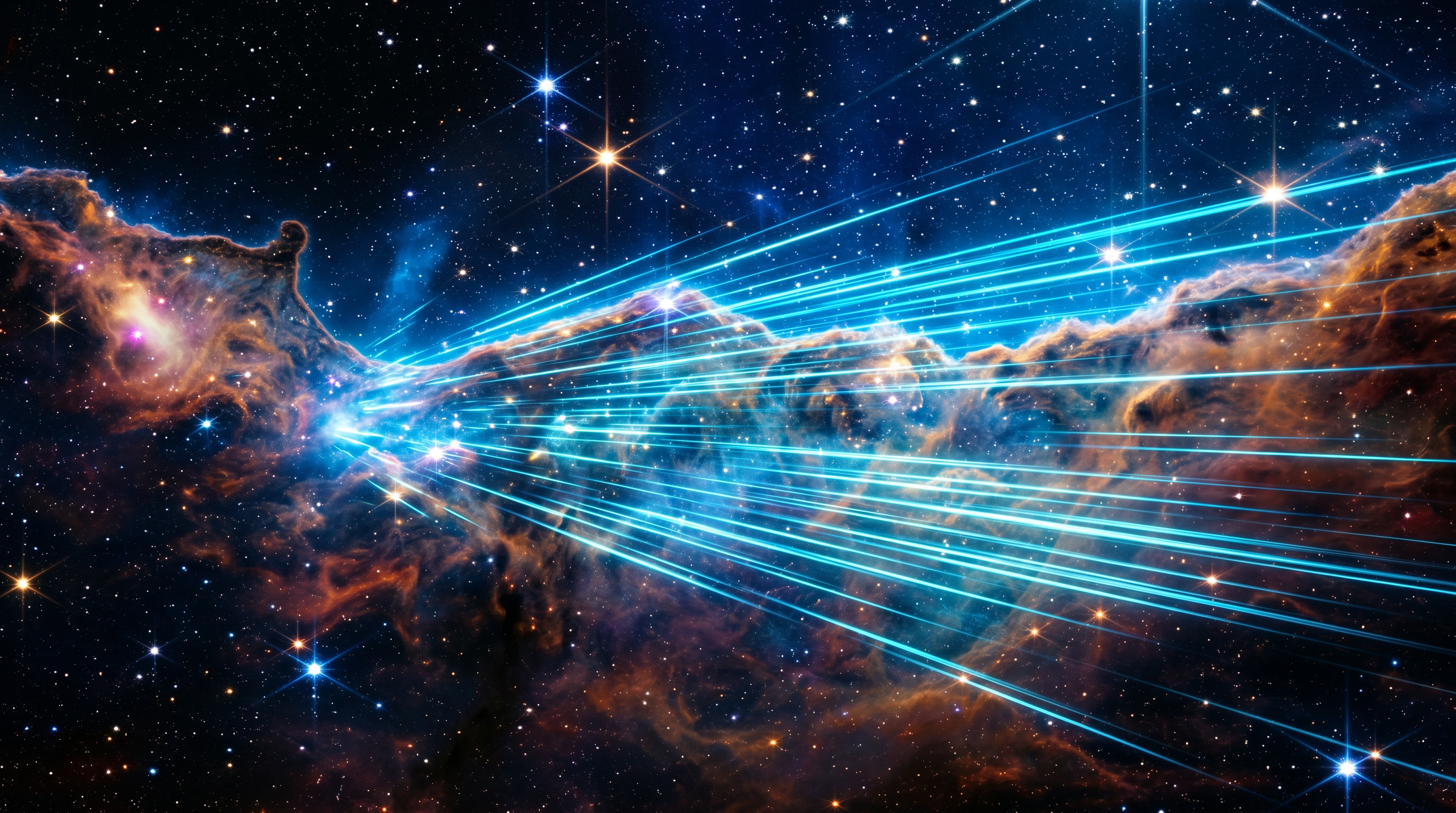
Speed of Light: Cosmic Speed Limit at 670 Million MPH – Light Years, KPH Conversions & Mind-Blowing Physics Facts
The Sheer Scale of the Speed of Light
Picture this: a beam of light bursts from a distant quasar, hurtling through the void at 670,616,629 miles per hour. That's the speed of light, the universe's ultimate benchmark, denoted as c in physics. It's not just fast—it's the cosmic speed limit, a fundamental constant etched into the fabric of reality. Why does this number grip our imagination? Because it bridges the infinitesimal and the infinite, challenging our senses while revealing the universe's grand design. From Einstein's revolutionary insights to the starlit skies above, the speed of light reshapes how we perceive time, space, and our place in the cosmos. For curious minds, students, and science enthusiasts, grasping c unlocks mind-blowing physics facts and the poetry of the stars.
The Precise Numbers Behind the Speed of Light
Let's pin down the exact figures. The speed of light in a vacuum is a fixed value: 299,792,458 meters per second. But speed units vary by context, making conversions essential for everything from astronomy to engineering. Here's c across key measures:
- Meters per second (m/s): 299,792,458 – the SI standard.
- Miles per second (mi/s): 186,282 – blistering even at this scale.
- Kilometers per second (km/s): 299,792 – a staple in space science.
- Miles per hour (mph): 670,616,629 – over half a billion!
- Kilometers per hour (kph): 1,079,252,849 – for global mph to kph conversion fans.
- Knots: 582,749,918 – nautical navigation's nod to light.
These aren't approximations; they're derived from rigorous measurement, with the meter itself now defined by c. Mastering these speed units illuminates physics facts that feel both alien and intimate.
The Cosmic Speed Limit: Why Nothing Goes Faster
Enter Einstein's special relativity: the cosmic speed limit isn't arbitrary—it's woven into spacetime. As objects approach c, their mass effectively increases, demanding infinite energy to accelerate further. Time dilation kicks in too; for a photon traveling at light speed, time freezes, and distances shrink to zero. Imagine firing a spaceship toward c: clocks slow, lengths contract, and the universe warps. This isn't sci-fi; GPS satellites adjust for it daily. Violating the speed of light would unravel causality—effects preceding causes. Physics facts like these remind us: light's pace governs reality itself.
Distance as Time: Decoding the Light-Year
Astronomers don't measure cosmic vastness in miles; they use the light year distance, the distance light travels in one Julian year—about 5.878 trillion miles (9.461 trillion km). It's time disguised as space. When we say Andromeda is 2.5 million light-years away, we're viewing it as it was 2.5 million years ago, a snapshot from antiquity. This unit scales the incomprehensible: our Milky Way spans 100,000 light-years, the observable universe 93 billion. The speed of light turns distance into history, letting us gaze into the past.
Galactic Travel Times: Putting Light Speed in Context
From Moon to Stars
Light from the Moon reaches Earth in 1.28 seconds. The Sun? 8 minutes and 20 seconds—blink, and you'd miss its glow. Mars varies from 3 to 22 minutes depending on orbit. Punchier still: Proxima Centauri, our nearest star beyond the Sun, is 4.24 light-years away. At c, that's 4.24 years one-way. Alpha Centauri? 4.37 years. The galactic center: 26,000 years. These physics facts highlight light's dual role as sprinter and marathoner across the void.
Human Speeds vs. the Cosmic Speed Limit
Now, stack humanity's best against light. A commercial jet cruises at 575 mph—0.00009% of c. A .220 bullet? 3,600 mph, still negligible. The Parker Solar Probe hits 430,000 mph (700,000 km/h), humanity's fastest at 0.064% c, yet it takes years to loop the Sun. Escape velocity from Earth: 25,000 mph. Even Voyager 1, at 38,000 mph, crawls toward interstellar space after decades. These contrasts underscore the cosmic speed limit's dominance.
The Paradox: Why 186,000 mi/s Feels 'Slow' for Interstellar Dreams
Here's the mind-bender: the universe's fastest speed is agonizingly slow for star-hopping. At c, reaching the galactic core demands 26,000 years—generations aboard a photon ship. Even nearby stars taunt us with multi-year journeys. Relativity forbids faster-than-light travel without exotic workarounds like wormholes, unproven and energy-hungry. This paradox fuels sci-fi while grounding us: light's pace, though immense, renders the galaxy a lonely outpost. It sparks profound physics facts about our technological horizon.
Master Conversion Table: Speed of Light Across Units
| Speed Unit | Value for c |
|---|---|
| Meters per Second (m/s) | 299,792,458 |
| Kilometers per Second (km/s) | 299,792 |
| Miles per Second (mi/s) | 186,282 |
| Miles per Hour (mph) | 670,616,629 |
| Kilometers per Hour (kph) | 1,079,252,849 |
| Knots | 582,749,918 |
This table is your go-to for mph to kph conversion and beyond, showcasing speed units in action.
SpeedShift Converter: The '8 and 5' Mental Math Trick
Harness the SpeedShift Converter mindset with this '8 and 5' hack for on-the-fly unit swaps. To convert mph to kph, multiply by 8/5 (1.60934 ≈ 1.6). For light: 670 million mph × 1.6 = roughly 1.07 billion kph. Reverse? Divide by 1.6 (or × 5/8). Mi/s to mph? × 3,600. Km/s to kph? Same. Practice on c: 186,282 mi/s × 3,600 ≈ 670 million mph. This trick demystifies speed units, turning conversions into intuition—perfect for physics enthusiasts crunching cosmic numbers mentally.
Embracing the Light: A Call to Cosmic Curiosity
The speed of light isn't just a number—it's the pulse of the universe, the cosmic speed limit that humbles and inspires. From light-year distances painting ancient skies to relativity's elegant barriers, these physics facts expand our minds. Next time you glance at the stars, remember: that twinkle left eons ago, racing at 670 million mph to meet your eye. Dive deeper, convert speeds, question limits. In understanding c, we touch infinity. Keep exploring—the universe awaits.