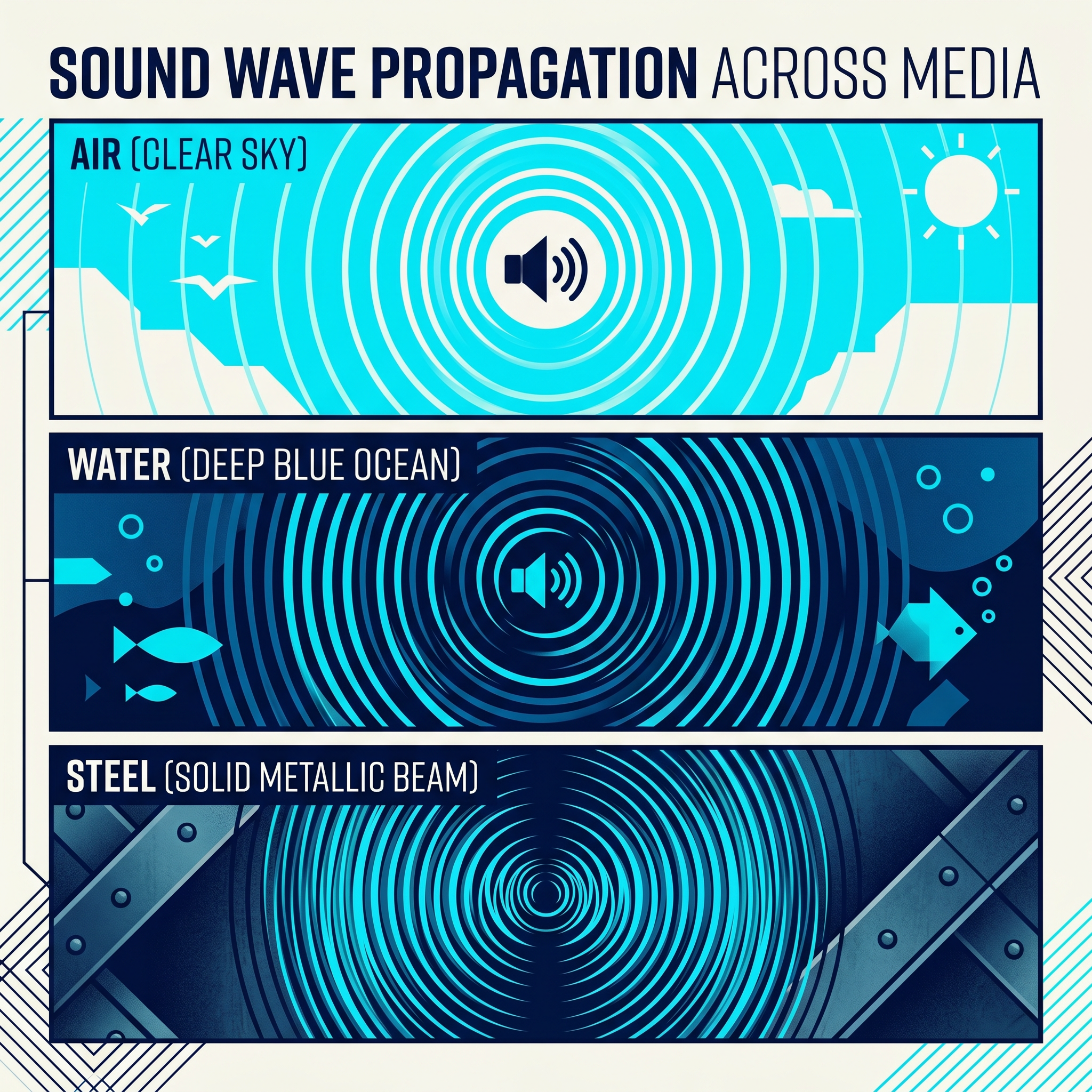
Speed of Sound Explained: Air (343 m/s) vs Water (1,482 m/s) vs Steel (5,960 m/s) – Mach Scale, Sonic Booms & Physics Secrets
Imagine a flash of lightning slicing through the night sky, followed by a distant rumble that takes several heartbeats to arrive. That gap? It's the speed of sound in air—343 meters per second—reminding us that light races ahead at 300,000,000 m/s, while sound plods along like a marathon runner. But what if that rumble traveled through water or steel instead? Suddenly, it's supersonic, clocking 1,482 m/s in water or a blistering 5,960 m/s in steel. Welcome to the fascinating world of sound propagation media, where the medium dictates the message's pace.
This isn't just trivia for science buffs; understanding the speed of sound in air vs water and solids like steel unlocks everyday mysteries—from why you feel a train's approach through iron rails before hearing its whistle to how submarines "see" with sonar. We'll unpack the physics secrets, explore the Mach scale, dive into sonic booms, and crunch real-world calculations. Buckle up for a sonic journey.
The Physics of Sound Speed: Molecules, Elasticity, and Density
Sound is no mystical wave; it's a mechanical vibration rippling through matter. Picture molecules as a crowd at a rock concert: when one shoves the next, the push propagates. The speed hinges on two stars—elasticity (how springy the medium is) and density (how packed the molecules are).
The formula boils down to v = √(B/ρ), where B is the bulk modulus (stiffness) and ρ is density. Gases like air have loose molecules bumping lazily, yielding 343 m/s at sea level and 20°C (about 767 mph or 1,235 km/h). Liquids pack tighter; water's hydrogen bonds make it 4x stiffer relative to density, hitting 1,482 m/s (3,315 mph or 5,335 km/h). Solids? Steel's rigid atomic lattice lets vibrations rocket at 5,960 m/s (13,330 mph or 21,456 km/h).
Molecular Proximity: The Key to Speed
Here's the secret sauce: molecular proximity. In air, molecules are 10 billionths of a meter apart, traveling 500 m/s between collisions—plenty of wiggle room slows the chain reaction. Water molecules huddle 3,000 times closer, slamming news faster. Steel atoms? Glued in a crystal grid, mere angstroms apart, transmitting shakes near-instantly. That's why sound travels through tracks faster than air: iron rails bypass airy gaps.
- Air: Sparse, compressible—slow.
- Water: Dense, incompressible—swift.
- Steel: Ultra-stiff lattice—blazing.
Speed of Sound in Air: Temperature, Altitude, and Thunder Calculations
Air's speed isn't fixed; it's finicky. At 20°C sea level, 343 m/s rules. But crank the heat to 30°C, and it climbs to 349 m/s (formula: 331 + 0.6T m/s, T in °C). Why? Hotter air means friskier molecules, zipping 0.6 m/s faster per degree.
Climb altitude, and it drops. Mount Everest's frigid -20°C and thin air slash it to ~300 m/s. Humidity tweaks it too—moister air, slightly faster.
Practical Example: How Far Was That Thunder?
Lightning flashes; thunder lags 5 seconds. Distance? Sound covers ~1,715 meters (343 m/s × 5 s ≈ 1 mile or 1.7 km). Rule of thumb: seconds ÷ 3 = miles away, ÷ 5 = km. This sounds propagation delay saved lives in ancient times—gauging storm proximity.
Speed of Sound in Water: 1,482 m/s and Sonar Magic
Diving deeper, speed of sound in air vs water flips the script. Water's 4.3x faster pace powers sonar: submarines ping echoes off hulls or seabeds. A 1-second round trip? Echo from 741 meters away (half of 1,482 m/s × 1 s).
Temperature layers matter—thermoclines bend sound rays like mirages. Salinity bumps it 1.3 m/s per ppt. Whales exploit this, chatting across oceans where air-sound fizzles.
Speed of Sound in Steel: 5,960 m/s and Rail Whisperers
Ever press an ear to train tracks? You hear the rumble before the air carries the whistle because speed of sound in steel crushes air's pace—17x faster. A vibration 1 km away arrives in 0.17 seconds via steel, vs. 3 seconds through air.
Steel varies by type—longitudinal waves at 5,960 m/s, shear at 3,200 m/s. This hyper-speed detects earthquakes (P-waves ~6 km/s in crust) or inspects welds ultrasonically.
Mach Scale Explained: From Subsonic to Hypersonic
Enter the Mach scale explained: a dimensionless ratio pegged to air's speed at altitude/temperature. Mach 1 = 343 m/s (sea level, 15°C). Commercial jets cruise Mach 0.8; fighters hit Mach 2.
In other media? Relative Mach: water's 1,482 m/s = Mach 4.3 (air baseline); steel Mach 17.4. But aviation sticks to air.
| Medium | m/s | km/h | mph | Mach (Air=1) |
|---|---|---|---|---|
| Air (20°C) | 343 | 1,235 | 767 | 1.0 |
| Water (20°C) | 1,482 | 5,335 | 3,315 | 4.3 |
| Steel | 5,960 | 21,456 | 13,330 | 17.4 |
Sonic Boom Physics: Breaking the Barrier
Sonic boom physics erupts past Mach 1. Compress waves pile into a shock cone, trailing a thunderous N-wave boom. Concorde's double-bang shook windows; modern jets skirt it subsonic.
In water or steel? No "booms" like air—media can't sustain the pressure gradient the same way. But bullets zip Mach 2+ through air, bullets cracking.
Why It All Matters: From Classrooms to Cockpits
Grasping speed of sound in air vs water, speed of sound in steel illuminates tech frontiers—ultrasound scans, seismic monitoring, hypersonic missiles. Next storm, time the thunder. Ear to the rail, feel the future arrive first.
Sound's pace reveals the universe's hidden rhythms: slow whispers in wind, urgent pulses in depths and depths of metal. The cosmos vibrates—now you know its tempo.