Hull Speed Explained: Boat Speed Calculator, Formula & Chart for Displacement Hulls (Knots to MPH)
What Is Hull Speed?
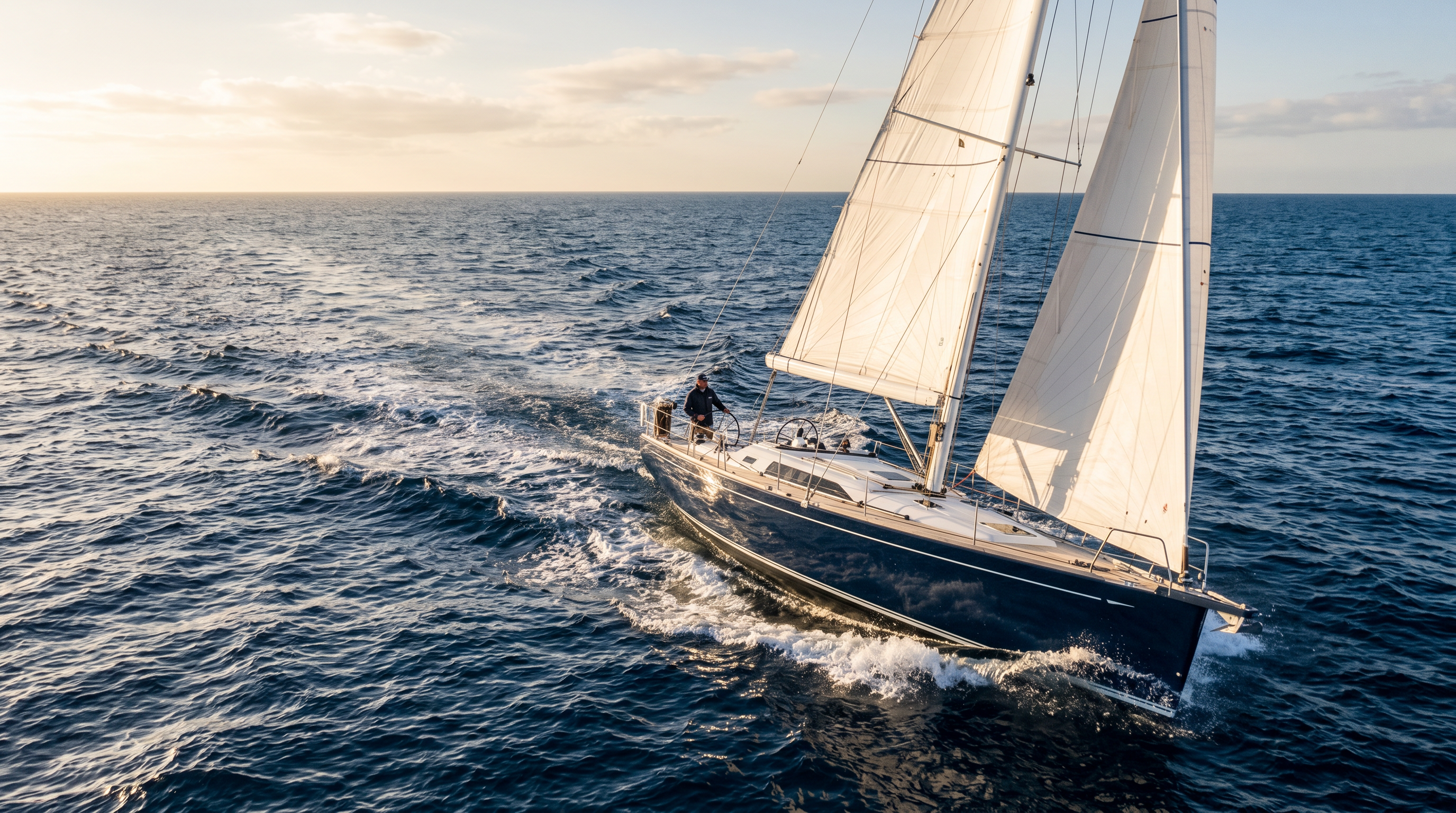
Picture this: You're out on the water with your displacement hull sailboat, sails full, wind steady. You push the throttle—or trim the sheets just right—and suddenly, no matter how hard you try, the boat refuses to go faster. It's like hitting an invisible wall. That's hull speed in action, the theoretical maximum speed for a displacement hull slicing through the water.
Hull speed marks the point where a boat's bow wave and stern wave align perfectly, trapping the hull in a deep trough. As the boat moves forward, it generates a bow wave that grows with speed. At the same time, a stern wave forms astern. When the wavelength of these waves equals the waterline length (LWL), the boat can't climb over its own bow wave. It's physically stuck, riding in that V-shaped valley between waves.
This isn't some arbitrary limit; it's pure physics. Understanding hull speed helps boat owners, sailors, and shoppers set realistic expectations for their vessel's maximum boat speed. Exceeding it on a displacement hull? Nearly impossible without revolutionary hull designs or massive power.
The Physics of Displacement Hulls
Displacement hulls work by pushing water aside rather than skimming over it. Think of them like a barge or classic sailboat: fully submerged, they displace their weight in water, following Archimedes' principle. But speed comes at a cost—wave-making resistance.
As velocity increases, the bow wave steepens. The boat tries to climb it, but the stern starts to squat, dragging the stern wave longer. At hull speed, these waves synchronize: crest-to-crest distance matches the LWL. The hull sits perched on the bow wave's crest, stern dangling in the trough. Adding power just makes bigger waves, not more speed.
This is the infamous "hull speed wall." Wave resistance skyrockets exponentially near this barrier—doubling power might gain you just 0.5 knots. It's why your trawler or sailboat feels efficient up to a point, then guzzles fuel for peanuts in performance. Frictional drag plays a role too, but wave-making dominates at these speeds.
For boat hull types like these, hull speed is the boat speed limit. Ignore it, and you're wasting fuel, stressing the engine, and risking safety.
How to Calculate Hull Speed
Ready for the hull speed formula? It's simple: Hull Speed (knots) ≈ 1.34 × √(waterline length in feet). The constant 1.34 comes from wave physics in saltwater (use 1.32 for freshwater). Waterline length (LWL) is key—longer hulls mean higher hull speed.
Let's crunch numbers for real boats. Grab your LWL from the specs (not overall length, LOA).
Example 1: 30-Foot Sailboat (LWL ≈ 25 ft)
√25 = 5. 1.34 × 5 = 6.7 knots.
MPH: 6.7 × 1.15078 ≈ 7.7 mph.
KPH: 6.7 × 1.852 ≈ 12.4 kph.
Example 2: 40-Foot Cruiser (LWL ≈ 36 ft)
√36 = 6. 1.34 × 6 = 8.04 knots.
MPH: 8.04 × 1.15078 ≈ 9.25 mph.
KPH: 8.04 × 1.852 ≈ 14.89 kph.
Example 3: 20-Foot Daysailer (LWL ≈ 18 ft)
√18 ≈ 4.24. 1.34 × 4.24 ≈ 5.68 knots.
MPH: 5.68 × 1.15078 ≈ 6.54 mph.
KPH: 5.68 × 1.852 ≈ 10.52 kph.
Plug your LWL into this boat speed calculator formula anytime. Apps and online tools use it too, but knowing the math empowers you.
Hull Speed Calculator Table
Knots to MPH and KPH conversions included. Use this hull speed chart for quick reference on displacement hulls.
| Waterline Length (ft) | Hull Speed (knots) | MPH | KPH |
|---|---|---|---|
| 15 | 5.2 | 6.0 | 9.6 |
| 20 | 6.0 | 6.9 | 11.1 |
| 25 | 6.7 | 7.7 | 12.4 |
| 30 | 7.3 | 8.4 | 13.6 |
| 35 | 7.9 | 9.1 | 14.7 |
| 40 | 8.5 | 9.7 | 15.7 |
| 45 | 9.0 | 10.3 | 16.6 |
| 50 | 9.5 | 10.9 | 17.5 |
| 55 | 9.9 | 11.4 | 18.4 |
| 60 | 10.4 | 11.9 | 19.2 |
Values rounded to one decimal. Your boat might vary slightly due to hull shape or conditions.
Displacement vs. Semi-Displacement vs. Planing Hulls
Not all boat hull types bow to hull speed. Here's the breakdown:
- Displacement Hulls: Classic sailboats, trawlers. Limited to hull speed. Efficient at low speeds, but power beyond that creates drag.
- Semi-Displacement Hulls: Beefier versions, like some motor yachts or lobster boats. Fine entry forward, transom partially submerged. They climb the bow wave slightly, hitting 1.5–2x hull speed (e.g., 12–15 knots on a 40-footer). More power-hungry than pure displacement.
- Planing Hulls: Speed demons—center consoles, ski boats. Flat or V-bottom aft. At speed, hydrodynamic lift pops them onto plane, skimming surface. No hull speed limit; 30+ knots common. But they guzzle fuel at idle.
Choose based on use: displacement for passagemaking, planing for day trips.
Real Examples of Common Boat Types
Let's see hull speed in the real world:
- Catalina 30 Sailboat (~25 ft LWL): 6.7 knots, 7.7 mph, 12.4 kph. Perfect for coastal cruising; pushing harder just heels more.
- Beneteau Oceanis 40 (~36 ft LWL): 8.0 knots, 9.2 mph, 14.8 kph. Solid bluewater speeds—efficient under sail or motor.
- Nordhavn 47 Trawler (~42 ft LWL): 8.7 knots, 10.0 mph, 16.1 kph. Designed for long-range at displacement efficiency.
- Boston Whaler 170 Montauk (planing hull): 30+ knots easy. Climbs plane, laughs at hull speed.
These show why sailors love the steady ride, while powerboaters crave the planing thrill.
Practical Implications for Boaters
Knowing your hull speed changes everything. Sailors: That 7-knot ceiling? Embrace it—it's where polars peak. Motor on a displacement hull? Cruise at 80–90% for best economy; full throttle squats the stern, spikes fuel burn 50%+ for tiny gains.
Boat shoppers: Check LWL first. Fancy a fast trawler? Semi-displacement might fit. Tiring of the boat speed limit? Go planing.
Safety note: Forcing speed overloads props, strains rigging. Respect physics—it's the ocean's way of keeping you humble.
Next time you're aboard, calculate your hull speed. It'll explain why your boat behaves like it does, turning frustration into mastery. Smooth sailing.