Master ETA Calculation at Sea: Knots to MPH Conversions, Dead Reckoning, and Voyage Planning for Coastal Cruisers & Offshore Sailors
Picture this: the sun dips low on the horizon, your coastal cruiser slices through glassy swells, and that distant harbor light flickers like a promise. But as the breeze freshens, you glance at the chart and wonder—will you make the inlet before dark? In sailing navigation, nailing your estimated time of arrival (ETA) isn't just a nice-to-have; it's the heartbeat of safe, stress-free voyaging. Whether you're a weekend coastal cruiser plotting a hop from Key West to the Dry Tortugas or an offshore sailor eyeing a transatlantic leg, mastering ETA calculation keeps you ahead of tides, weather, and fatigue.
This guide strips away the mystery. We'll break down the math simply, dive into dead reckoning as your no-fail backup, tackle why boat speeds dance with the sea, and blend old-school smarts with GPS wizardry. By the end, you'll plan voyages with the confidence of a salty veteran. Let's hoist the sails and get calculating.
The ETA Formula: Speed, Distance, and Time Demystified
At its core, ETA calculation boils down to one timeless equation: Time = Distance ÷ Speed. In nautical terms, distance is measured in nautical miles (NM), speed in knots (1 knot = 1 NM per hour), and time in hours. Your arrival time? Add that to your departure.
But landlubbers often ask for boat speed knots to mph conversions. One knot equals about 1.15 mph (precisely 1.15078 mph) or 1.852 kilometers per hour (kph). Why bother? If you're briefing crew from car-driving backgrounds or logging in statute miles, it bridges worlds. Use tools like getspeedconvert.com for spot-on figures, but memorize: 5 knots ≈ 5.75 mph, 7 knots ≈ 8.06 mph.
Worked Example 1: Coastal Hop in Knots
You're coastal cruising from Annapolis to Solomons Island: 28 NM at an average 5.5 knots.
- Time = 28 ÷ 5.5 ≈ 5.09 hours (5 hours, 5 minutes).
- Depart 0900: ETA 1405.
Convert speed: 5.5 knots × 1.15 ≈ 6.33 mph. Distance in statute miles? 1 NM = 1.15 statute miles, so 28 NM ≈ 32.2 miles. Time = 32.2 ÷ 6.33 ≈ 5.09 hours. Same result—proof the math holds across units.
Worked Example 2: Offshore Leg with KPH
Bermuda to Newport: 640 NM at 8 knots (14.6 kph).
- Time = 640 ÷ 8 = 80 hours (3 days, 8 hours).
- Speed in mph: 8 × 1.15 ≈ 9.2 mph.
Pro tip: Break long hauls into day-bites. 80 hours? Plan 12-hour watches, factoring reefing if winds build.
Dead Reckoning: Your Anchor in the Analog Age
Dead reckoning—the art of plotting position from speed, course, and time—has guided sailors since square-riggers ruled the waves. No GPS? No problem. It's pure ETA calculation fused with compass and log.
Start with a fix (visual bearing or GPS ping). Note course (true or magnetic), speed through water (from knotmeter), and leeway (wind-push angle). Plot on paper charts: every hour, advance your DR position by speed × time along course.
- Compass check: Steer 090°M, 6 knots, 1 hour = 6 NM east.
- Leeway tweak: 10° off in 20-knot beam wind? Adjust course upwind 5-10°.
- Current vector: 1 knot flood? Add as a triangle leg.
For voyage planning, DR shines in fog or electronics failure. Practice on short coastal cruises: log speed every 15 minutes, plot DR, compare to GPS. You'll build intuition faster than any app.
Why Boat Speed Varies—and How to Factor It In
Sea state isn't a steady hand. Your 7-knot pollywog in flat water might crawl at 4 knots beam-on to chop. Winds shift, hull fouls, sails bag—speed fluctuates 20-50% easy.
Account for it: Log polar diagrams (speed by angle of wind) or real runs. Coastal cruisers average 70% of max hull speed (√LWL in feet × 1.34); offshore sailors pad 10-20% for squalls.
Practical Adjustments
- Tides/currents: Subtract set/drift from SOG (speed over ground).
- Weather windows: Forecast GRIBs; cut speed 15% for 25+ knots.
- Fuel/sail plan: Motor 6 knots, sail 5? Hybrid ETA = blended average.
Example: 40 NM coastal run, 6 knots ideal, but 20% reef-down penalty = 4.8 knots effective. ETA = 40 ÷ 4.8 ≈ 8.3 hours. Build buffers—better early than groping anchors in the dark.
GPS and Chartplotters: ETA on Autopilot
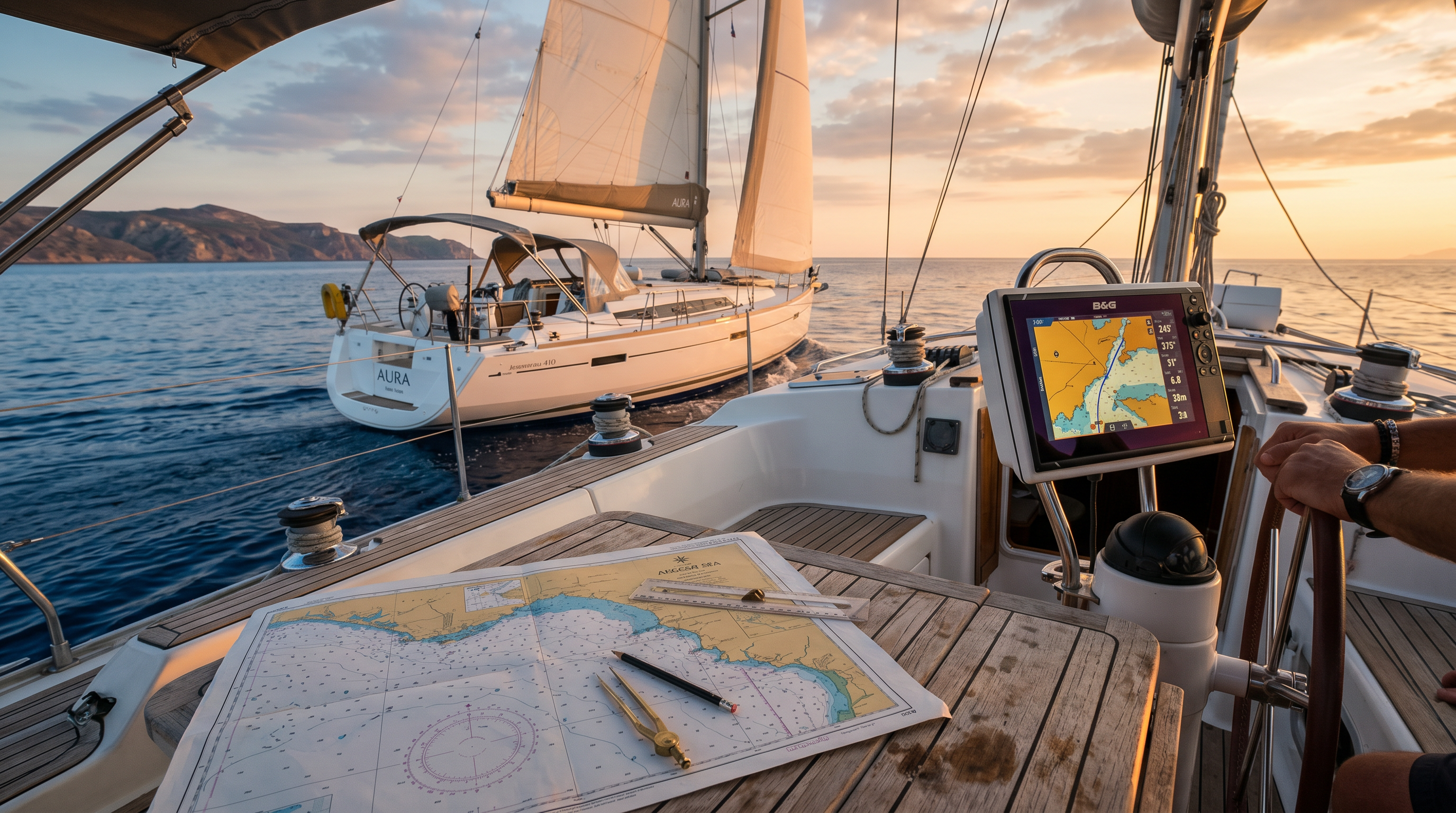
Modern chartplotters (Raymarine, Garmin) crunch ETA calculation in real-time using SOG, COG (course over ground), and rhumb line or great-circle routes. They factor currents via integrated data.
But don't zombie out: Cross-check with DR. GPS assumes straight-line; tacks, dodges, or man-overboards skew it. For offshore sailing, layer with satellite comms for dynamic updates.
Coastal cruisers love waypoint ETAs—set legs, watch times shrink as you surf tides. Pro move: Input conservative SOG (your 24-hour average) for realistic estimated time of arrival.
Voyage Planning Tips for Coastal Cruisers and Offshore Sailors
Coastal Cruising Checklist
- Print charts + plotter backup.
- Calculate ETAs per leg, add 25% tide buffer.
- Dead reckoning every fix; log religiously.
- Check VHF weather at dawn.
Offshore Sailing Blueprint
- Route via PredictWind; optimize for VMG (velocity made good).
- Daily noon-to-noon runs for true average speed.
- Pad ETAs 30% for gales, autopilot naps.
- Share positions via Iridium—crew peace of mind.
Encouraging word: Start small. That first 50 NM overnight? It'll hook you. Refine with each sail; soon, ETAs feel like second nature.
Fair Winds and Accurate ETAs
Mastering ETA calculation, dead reckoning, and smart voyage planning transforms sea time from gamble to glide. Coastal cruisers, savor those sunset arrivals; offshore sailors, chase horizons with precision. The ocean rewards the prepared—now go make yours count. What's your next leg? Chart it, calculate it, conquer it.