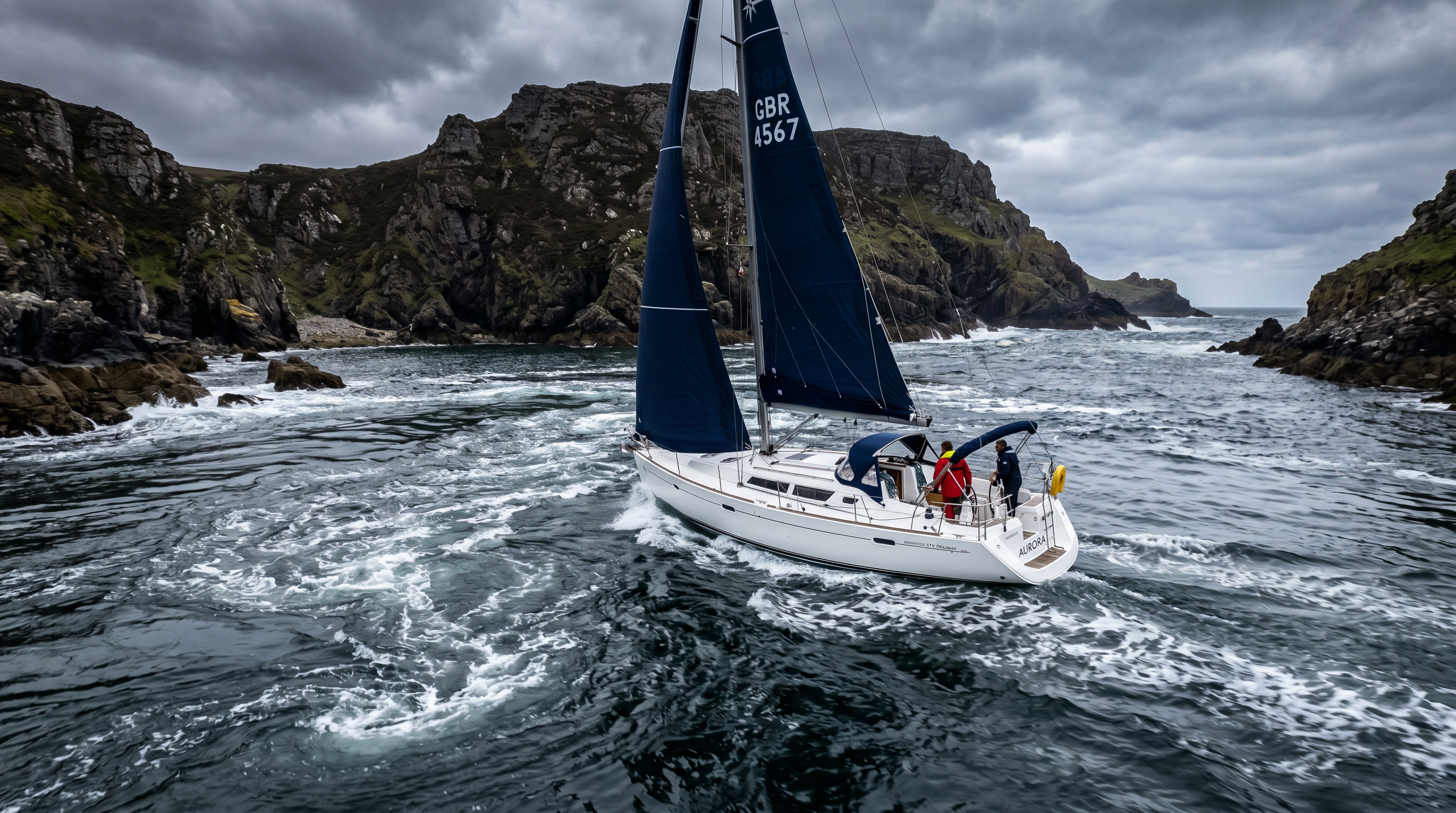
SOG vs STW: Master Speed Over Ground, Tidal Currents, Tide Tables & Rule of Twelfths for Safe Coastal Navigation
Picture this: you're clipping along at what feels like a steady 5 knots, sails full and spirits high, only to glance at the GPS and see your speed over ground (SOG) hovering at a measly 2 knots. The water rushes past your hull, but the seabed barely budges. That's the tidal current at work—a invisible force that can turn a leisurely coastal sail into a battle against nature. For sailors, coastal boaters, kayakers, and anyone tackling tidal waters, mastering speed through water (STW) versus SOG isn't just nautical nerdery; it's the key to safe, efficient coastal navigation.
In these pages, we'll dive deep into how tidal currents hijack your boat speed, decode tide tables and current charts, apply the Rule of Twelfths, and arm you with real-world math to plan passages that keep you safe. Because in tidal zones, ignoring the current isn't just slow—it's dangerous.
Speed Through Water (STW) vs Speed Over Ground (SOG): The Core Difference
Speed through water (STW) measures how fast your boat moves relative to the surrounding water. It's what your log or paddlewheel speedometer reads—the raw performance of your hull slicing through the sea, driven by wind, engine, or paddle. A well-trimmed sailboat might log 6 knots STW on a beam reach; a kayak paddler could hit 3 knots with strong strokes.
Speed over ground (SOG), on the other hand, is your true progress across the chartplotter or GPS screen—your velocity relative to the fixed seabed. GPS doesn't lie: it factors in every drift from wind, waves, and—crucially—tidal current. In still water, STW and SOG match perfectly. But introduce a 2-knot ebb tide, and suddenly SOG plummets if you're fighting it head-on.
Think of it like a river conveyor belt. Your STW is your walking speed on the belt; SOG is how fast you cover ground. Kayakers feel this acutely in narrow tidal straits, where even a gentle current can sweep you miles off course.
Tidal Currents: Boosting or Battling Your Boat Speed
Tidal currents are the ocean's pulse, driven by the moon's gravitational tug, flooding in (flood tide) or ebbing out (ebb tide) at speeds from 0.5 to 5+ knots in coastal hotspots. The simple equation governing your trip? SOG = STW ± tidal current speed, vectorially aligned with course.
Sailing with the current? You're "making way"—STW adds to the flow. A 6-knot STW boat on a 2-knot favorable current hits 8 knots SOG, slashing passage times. Against it? You're "fighting the current"—subtract, and that same boat crawls at 4 knots SOG, doubling your fuel burn or paddle fatigue.
Pro tip: Aim to stem the tide diagonally, balancing STW and current vectors for optimal SOG toward your waypoint. And remember conversions for landlubber friends—1 knot equals 1.15 mph or 1.85 kph. That 2-knot current? It's 2.3 mph stealing your progress.
Decoding Tide Tables and Current Charts for Coastal Navigation
Tide Tables: Heights and Timing
Tide tables list high and low water times and heights for reference ports. Adjust for your location using nautical almanacs or apps—secondary ports follow patterns offset by travel time along the coast. Slack water (zero current) hits mid-flood and mid-ebb; plan departures then to minimize drift.
Current Charts and Tidal Atlases
Current charts (or tidal stream atlases) are gold: diamonds or arrows show direction and speed at hourly intervals. A bold arrow at HW (high water) +2 means 2.5 knots northeast. Flood currents run into bays; ebb spills seaward. Kayakers: print these for cockpit reference—apps like Navionics overlay them live.
- Flood: Incoming tide, current toward shore.
- Ebb: Outgoing, seaward push.
- Spring tides (full/new moon): Stronger currents, neaps weaker.
Real-World Examples: How a 2-Knot Tidal Current Transforms Passage Times
Let's crunch numbers for a 10-nautical-mile coastal leg. Time = Distance / SOG (in hours). Why nautical miles and knots? One knot covers one nautical mile per hour—perfect for sea travel. (Quick convert: 10 nm ≈ 11.5 statute miles or 18.5 km.)
| Boat STW | Current | SOG | Time for 10 nm (hours) | Time (hours:minutes) |
|---|---|---|---|---|
| 6 knots | 0 (slack) | 6 knots | 1.67 | 1:40 |
| 6 knots | +2 (with) | 8 knots | 1.25 | 1:15 |
| 6 knots | -2 (against) | 4 knots | 2.50 | 2:30 |
| 4 knots (kayak) | -2 (against) | 2 knots | 5.00 | 5:00 |
See the swing? Against a 2-knot (2.3 mph) current, your sailboat's trip stretches 50% longer. For kayakers, it's triple the effort—plan around slack or favorable flow.
The Rule of Twelfths: Quick-Estimating Tidal Current Strength
No current chart? Fall back on the Rule of Twelfths, a skipper's shorthand for the tidal cycle's non-linear curve. Currents (like heights) build slowly, peak mid-cycle, then fade symmetrically over ~6 hours from slack to slack.
Divide max current speed by 12:
- Hours 1 & 6: 1/12 max
- Hours 2 & 5: 2/12
- Hours 3 & 4: 3/12
Example: 4-knot peak ebb. At +1 hour from slack: ~0.33 knots. +3 hours: ~1 knot. Rough but reliable for sailing safety—pair with tables for precision.
Worst-Case Scenarios: When Currents and Winds Collide
Currents against prevailing wind brew chaos: steep overfalls (breaking waves in smooth water), tide races (whirlpools and roostertails), and confused seas that swamp cockpits or flip kayaks. Portland Race off Maine or Raz Blanchard in France hit 10+ knots—timing misses these.
Golden rule: Leave on favorable current, arrive before it turns foul. Monitor forecasts; respect local knowledge from charts noting "violent races." Your lifejacket and VHF are backups, but prevention trumps reaction.
In tidal waters, sailing safety hinges on respect. One foul current can ground you on a lee shore faster than you can say "slack water."
Why Knots Rule Maritime Speed—and Quick Conversions
Knots endure because nautical miles (6076 ft) match latitude minutes—ideal for eyeball navigation. Convert for highways: 6 knots STW = 6.9 mph or 11.1 kph. GPS handles it seamlessly, but quote knots for precision in coastal navigation.
Chart Your Safe Passage
From STW illusions to SOG reality, tide tables to Rule of Twelfths, you've got the tools. Next outing, plot with current arrows, time for slack, and watch SOG soar. Tidal waters reward the prepared—fair winds, and always prioritize sailing safety.