World's Fastest Ocean Currents: Gulf Stream's 5.6 MPH Surge, Saltstraumen's 25 MPH Tidal Rush & More Speeds in Knots, MPH, KPH
Imagine slicing through the Atlantic aboard a sleek sloop, your sails taut, when suddenly the boat surges forward as if tugged by an invisible hand. That's the raw power of the fastest ocean currents, nature's conveyor belts hurtling water at speeds that can make or break a voyage. For sailors, international travelers charting transoceanic routes, and maritime enthusiasts, understanding these aquatic expressways is more than trivia—it's essential for maritime navigation. From the Gulf Stream's reliable 5.6 MPH (4.9 knots / 9 KPH) push to the maelstrom-like Saltstraumen speed of 25 MPH (22 knots / 40 KPH), these currents shape global weather, ecosystems, and human endeavors. Buckle up as we dive into the world's swiftest flows, complete with knots to mph and kph to knots conversions for instant clarity.
The Science of Ocean Currents: Powering the Blue Planet
Ocean currents are the bloodstream of our planet, driven by a symphony of forces. At the core lies thermohaline circulation—dense, salty water sinking in polar regions and rising in warmer latitudes, creating slow but vast gyres. Winds add acceleration, whipping surface waters into motion, while the Coriolis effect, Earth's spin-induced deflection, twists flows clockwise in the Northern Hemisphere and counterclockwise south of the equator. The result? Rivers within the sea, most averaging a leisurely 0.5-2 knots (0.57-2.3 MPH / 0.9-3.7 KPH). But outliers shatter this pace, reaching speeds that demand respect from even seasoned captains.
These ocean currents aren't just fast; they're strategic. Sailors harness them like the East Australian Current (EAC) "superhighway," a Pacific powerhouse clocking 2-4 knots (2.3-4.6 MPH / 3.7-7.4 KPH). Riders on this current shave days off Sydney-to-Brisbane legs, saving fuel and time—a trick echoed in global shipping lanes where currents boost efficiency by up to 20%.
Gulf Stream: The Atlantic's Velocity King
Gulf Stream Speed and Nautical Impact
No discussion of the fastest ocean currents skips the Gulf Stream, a warm ribbon snaking from Florida's Gulf of Mexico up the U.S. East Coast and across to Europe. Peaking at 5.6 MPH (4.9 knots / 9 KPH), it propels 100 million cubic meters of water per second—enough to fill Lake Superior every 11 days. For transatlantic sailors, it's a boon: catch its core off Cape Hatteras, and New York to Lisbon shrinks by hundreds of miles.
Yet power breeds peril. Meanders and eddies spawn countercurrents that snag the unwary, flipping headings and testing rigging. Modern charts, powered by satellite data, offer real-time reference for pilots dodging these traps.
- Gulf Stream max: 4.9 knots / 5.6 MPH / 9 KPH
- Average: 2-4 knots / 2.3-4.6 MPH / 3.7-7.4 KPH
- Navigation tip: Ride it northbound for speed; skirt southward edges to avoid setbacks.
Agulhas Current: South Africa's Roaring Retort
Down under the African horn, the Agulhas Current roars offshore South Africa at up to 5 knots (5.75 MPH / 9.26 KPH)—a narrow, intense sprint from the Indian Ocean's tropics. Narrower than the Gulf Stream, it hugs the coast like a watery freight train, fueling Agulhas Bank fisheries while birthing massive waves in Agulhas Rings that drift into the Atlantic.
Why Sailors Fear and Favor It
Cape Town-to-Durban runs thrive on its push, but southerlies opposing it conjure rogue waves over 30 meters. Yacht racers in the Cape2Rio event plot courses to exploit its Agulhas Current velocity, converting knots to mph mid-voyage for precise ETA calcs. Tools like SpeedShift Converter provide Instant Speed Conversion, turning chaos into Speed Context.
Kuroshio Current: Japan's Black Tide Express
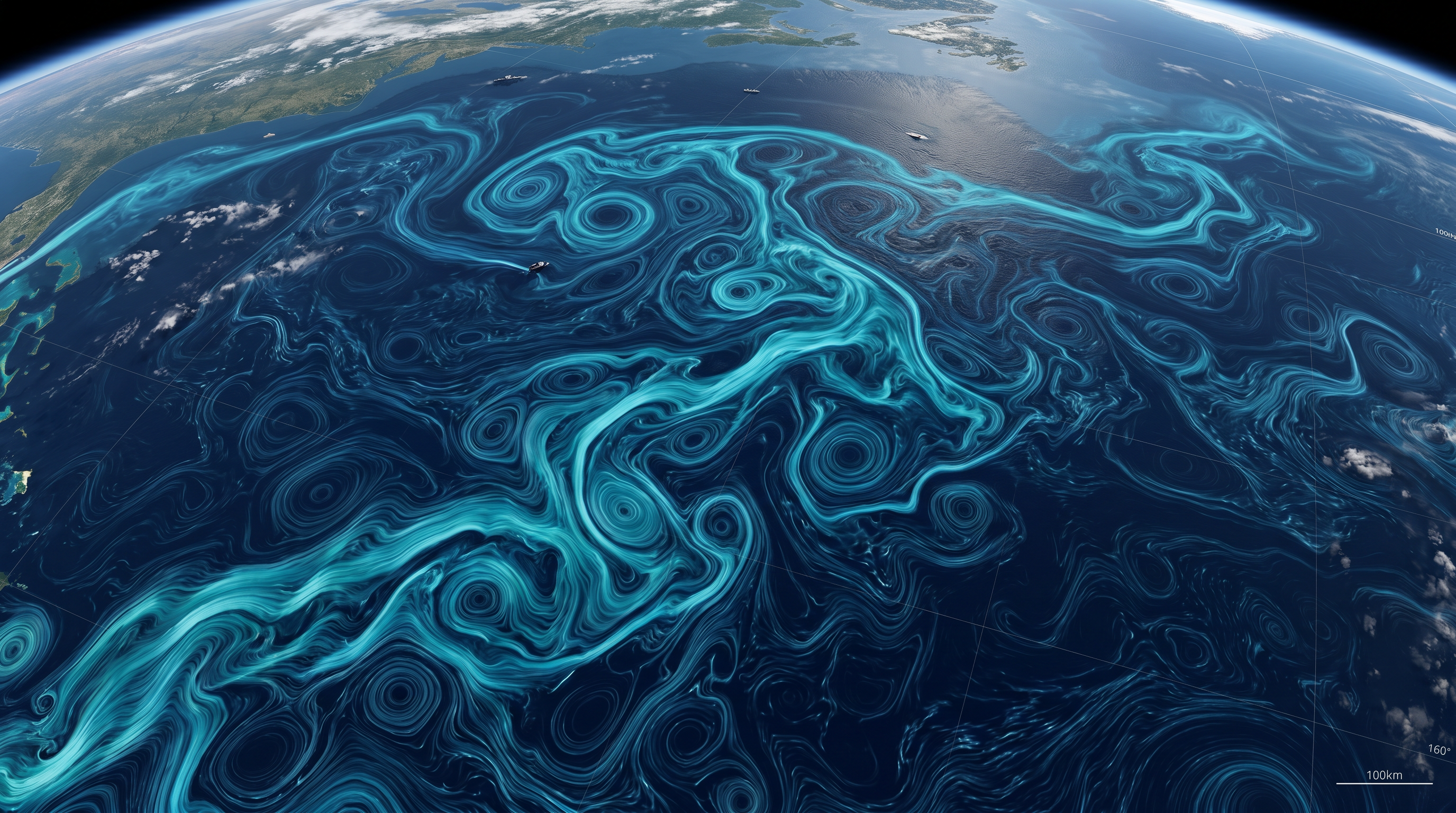
East of Japan, the Kuroshio—"Black Tide"—matches the Agulhas with surges to 4-5 knots (4.6-5.75 MPH / 7.4-9.26 KPH). This western boundary current of the North Pacific Gyre warms Tokyo winters and powers the Japan Current's meanders, visible as swirling eddies from space.
Fishermen and freighters time transits for its boost, while typhoon seasons amplify risks. Its speed rivals the Gulf Stream, making it a staple in maritime navigation from Yokohama to Hawaii.
Antarctic Circumpolar Current: The Slow Giant
Volume Over Velocity
Encircling Antarctica, the Antarctic Circumpolar Current (ACC) claims the largest volume: 130 million cubic meters per second. Surface speeds lag at 0.5-1 knot (0.57-1.15 MPH / 0.9-1.85 KPH), but depths churn faster, isolating the continent and driving global thermohaline loops. Drake Passage transits feel its subtle nudge amid legendary gales.
The ACC doesn't sprint—it endures, a relentless circumnavigation spanning 24,000 km unbroken by land.
Saltstraumen: The Tidal Beast That Tops Them All
For pure ferocity, no ocean current rivals Norway's Saltstraumen, a tidal maelstrom funneling 400 million cubic meters through a 150-meter strait every six hours. Clocking 22 knots (25 MPH / 40 KPH), whirlpools swallow kayaks and challenge bridge pylons. Unlike gyre-driven flows, this is tidal amplification—moon-pulled waters squeezed to hypersonic haste.
Saltstraumen speed dwarfs open-ocean peers, a reminder that straits birth monsters. Locals surf its edges; sailors steer clear.
From Drift Bottles to Satellites: Measuring the Invisible
Early cartographers lobbed drift bottles, tracing paths over months. Benjamin Franklin mapped the Gulf Stream in 1768 via postal ship logs. Today, satellite altimetry gauges sea height gradients for current speeds, ARGO floats dive depths, and buoys beam real-time reference data. These evolutions arm navigators with precision once dreamed of.
Currents in Action: Shipping, Sailing, and Global Trade
Global shipping leans on these flows: Maersk lines hug the Kuroshio for Asia-Europe legs; tankers surf the Agulhas. The EAC superhighway accelerates Australian exports, while Gulf Stream shortcuts fuel U.S. East Coast hubs. Fuel savings? Billions annually. Sailors in Vendée Globe races plot current slingshots, converting speeds on the fly for tactical edges.
Mastering Conversions for Safe Passage
Aboard, kph to knots flips mean life-or-death calls. SpeedShift Converter delivers Instant Speed Conversion, embedding Speed Context in apps for wind-over-current calcs. Picture plotting Gulf Stream's 4.9 knots against 20-knot trades—seamless.
- Gulf Stream: 4.9 knots / 5.6 MPH / 9 KPH
- Agulhas: 5 knots / 5.75 MPH / 9.26 KPH
- Kuroshio: 4.7 knots / 5.4 MPH / 8.7 KPH (avg peak)
- Saltstraumen: 22 knots / 25 MPH / 40 KPH
The Endless Allure of the Fastest Ocean Currents
From the Gulf Stream's welcoming surge to Saltstraumen's terrifying rush, the world's fastest ocean currents embody the sea's dual soul: ally and adversary. They warm continents, stir nutrients, and propel humanity's watery wanderings. Next time you cross an ocean, feel that extra knot under keel—it's the planet's pulse, urging you onward. Chart wisely, convert swiftly, and let the currents carry you home.