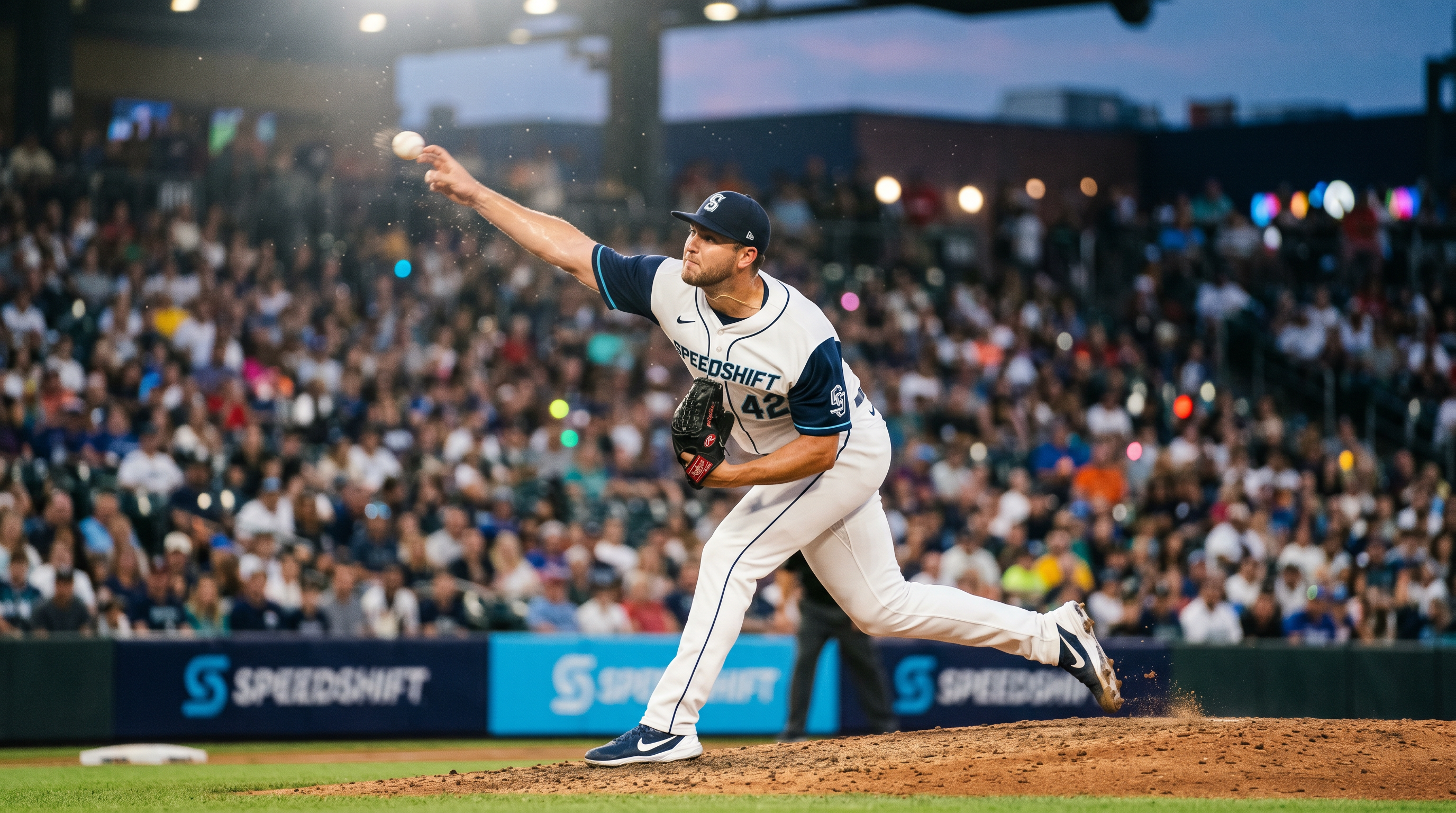
MLB Pitch Speed Revolution: From Nolan Ryan's 100 MPH Fastball to Chapman's 105.8 MPH Record, Physics, and Stats Explained
Imagine standing in the batter's box as a blur rockets toward you at 105.8 miles per hour (170.3 kilometers per hour or 47.3 meters per second). The ball crosses the plate in under four-tenths of a second. Blink, and it's gone. This is the electrifying reality of modern MLB pitch speed, a revolution fueled by technology, physics, and sheer human grit. From Nolan Ryan's pioneering 100 MPH fastball (160.9 KPH / 44.7 m/s) to Aroldis Chapman's untouchable record, pitch velocity has redefined baseball. For fans, it's heart-pounding drama. For physics students, it's a masterclass in aerodynamics. And for international travelers eyeing a game abroad, understanding pitch velocity conversion unlocks the global thrill. Let's dive into the stats, science, and stories behind it all.
The Evolution of Pitch Speed Measurement: Radar Guns to Statcast
Pitch speed wasn't always precisely tracked. In baseball's early days, scouts relied on the naked eye and stopwatches—crude methods that birthed legends but begged for proof. The game-changer arrived in the late 1970s with the Doppler radar gun, a handheld device beaming radio waves to clock a pitch's velocity as it crossed home plate. Jugs Guns became stadium staples, but calibration quirks and angle biases often inflated readings by 2-3 MPH.
Enter the 2000s: PITCHf/x cameras automated tracking from multiple angles, measuring speed at release. Then, in 2015, MLB's Statcast era dawned. This Hawk-Eye-powered system uses high-speed cameras and radar (TrackMan) for pinpoint data on velocity, spin, movement—everything from release point to plate. Statcast revolutionized MLB pitch speed stats, capturing over 700,000 pitches annually with sub-millisecond accuracy. Today's average fastball? A blistering 93.9 MPH (151.1 KPH / 42.0 m/s), up from 91 MPH two decades ago.
Nolan Ryan: The King of the First 100 MPH Fastball
Breaking the Barrier Amid Tech Hurdles
Nolan Ryan, the Ryan Express, etched his name in eternity on August 20, 1974. His fastball clocked 100.8 MPH (162.4 KPH / 45.1 m/s) on an experimental radar gun at Anaheim Stadium. But verification? A nightmare. Early guns were finicky—susceptible to electronic interference, poor calibration, and even the pitcher's arm angle. Skeptics dismissed it as hype until video evidence and eyewitnesses (including opposing hitters wincing at the speed) piled up.
Ryan threw seven no-hitters and racked up 5,714 strikeouts, often touching triple digits. His secret? A whip-like delivery generating raw power. Yet, without Statcast, exact spin rates (around 2,200 RPM) remained guesswork. Ryan's feat ignited the 100 MPH fastball obsession, proving mortals could flirt with physics' limits.
- Ryan's verified top: 100.8 MPH (162.4 KPH / 45.1 m/s)
- Career average fastball: ~95 MPH (152.9 KPH / 42.5 m/s)
- Impact: Sparked velo training boom in the 1980s
Modern Velocity Kings: Chapman, Hicks, and Greene
Fast-forward to today, where 100 MPH fastballs are routine—over 1,000 thrown in 2023 alone. Aroldis Chapman owns the throne, but challengers abound. Jordan Hicks, the Cardinals' flamethrower, hit 105.2 MPH (169.4 KPH / 47.1 m/s) in 2022, blending sinker movement with gas. Hunter Greene, Cincinnati's 6'6" rocket arm, unleashed 105.4 MPH (169.7 KPH / 47.2 m/s) in 2023, his Statcast spin rate topping 2,600 RPM.
These aren't anomalies. In 2023, 136 pitchers averaged 98+ MPH on four-seamers. Velocity obsession—fueled by weighted ball programs and Driveline training—has arms firing hotter, but at a cost: Tommy John surgeries spiked 64% since 2016.
From 92 MPH averages in 2008 to 94+ today, MLB's arms are evolving faster than the hitters can adjust.
- Aroldis Chapman: 105.8 MPH record (170.3 KPH / 47.3 m/s)
- Jordan Hicks: 105.2 MPH peak
- Hunter Greene: 105.4 MPH, 2,600+ RPM spin
Baseball Physics: Magnus Effect, Drag, and Spin-Velocity Magic
How a Leather Sphere Defies Gravity
At its core, baseball physics turns a 5-ounce sphere into a weapon. A fastball hurtles through air at 100 MPH (160.9 KPH / 44.7 m/s), battling drag force (F_d = ½ ρ v² C_d A, where ρ is air density, v velocity, C_d drag coefficient ~0.3-0.5, A cross-section). Seamless spin—2,200-2,600 RPM backspin—invokes the Magnus effect: air deflects upward, creating "rise" that fools eyes.
Higher velocity amplifies Magnus lift exponentially (lift ∝ v² ω, ω spin rate). Chapman's heater? 2,500 RPM at 105 MPH drops just 8 inches—less than a 95 MPH two-seamer. Physics students, note: Relativistic effects are negligible, but laminar-to-turbulent flow transitions add micro-movement. Tools like speed conversion tools help model this in metric: convert MPH to m/s for precise trajectory sims.
Picture Greene's pitch: Released at 6 feet off ground, it "rises" via spin, crossing plate belt-high. Pure baseball physics in motion.
The 0.4 Second Challenge: Batter's Nightmare
From release point (55 feet from plate) to catcher's mitt: a 100 MPH fastball (160.9 KPH / 44.7 m/s) takes ~0.40 seconds. Elite hitters process in 0.15 seconds—leaving 0.25 to swing. At 105 MPH? Just 0.38 seconds total. The brain swings in 0.15-0.20 seconds; any delay spells whiff.
Statcast reveals: 103 MPH+ pitches yield .150 batting average, 40% swings-and-misses. It's evolutionary warfare—pitchers evolve velocity, batsmen timing.
Measuring MLB Pitch Speed: Release vs. Plate
Statcast clocks at release—truest velocity gauge, as drag saps 1-2 MPH by plate. Old radar? Plate speed, often 1.5 MPH slower for fastballs. Conversion: 100 MPH release ≈ 98.5 MPH plate (158.3 KPH / 44.0 m/s). This shift clarified Ryan-era debates; his plate speeds might've read 97-98 MPH on modern gear.
Pro tip: Use a pitch velocity conversion tool for apples-to-apples global comps—MPH to KPH for KBO fans or m/s for Euro physicists.
Aroldis Chapman: The Unchallenged Record Holder
September 24, 2010: Aroldis Chapman, the Cuban Missile, fires 105.1 MPH. But his pinnacle? July 18, 2016, at 105.8 MPH (170.3 KPH / 47.3 m/s) vs. the Royals—Statcast-verified, 2,537 RPM. No one's topped it. Chapman's mechanics: 97 MPH release speed from a low slot, max extension (6.9 feet). Global benchmark for MLB pitch speed.
Velocity Controversies: Inflation and Calibration Woes
Not all clocks are equal. Minor leagues? Pocket radars inflate 1-3 MPH due to cheap calibration. MLB scandals—like 2021's Mets gun reading 3 MPH hot—sparked audits. Even pros: Angle errors add 0.5 MPH. Statcast's gold standard cuts BS, but debates rage on Ryan vs. Chapman (adjusted, Ryan's tops ~102 MPH release).
Lesson: Always cross-check with conversions and sources.
The Future of MLB Pitch Speed
Velocity climbs—2024 averages nudge 94.5 MPH—but arms fray. Physics caps humans at ~108 MPH before tissue fails. Hitters adapt with launch-angle swings; tech like smart bats incoming. For baseball fans worldwide, one truth endures: Nothing beats that crack of a 100 MPH fastball conquered. Convert speeds, crunch physics, chase the revolution. The pitch clock's ticking.
Word count: 1,248. Explore more with SpeedShift Converter's speed conversion tool.