CPU Clock Speed Explained: GHz Meaning, MHz vs GHz History, IPC Myths & Overclocking Records
What Does Gigahertz Really Mean for Your Processor?
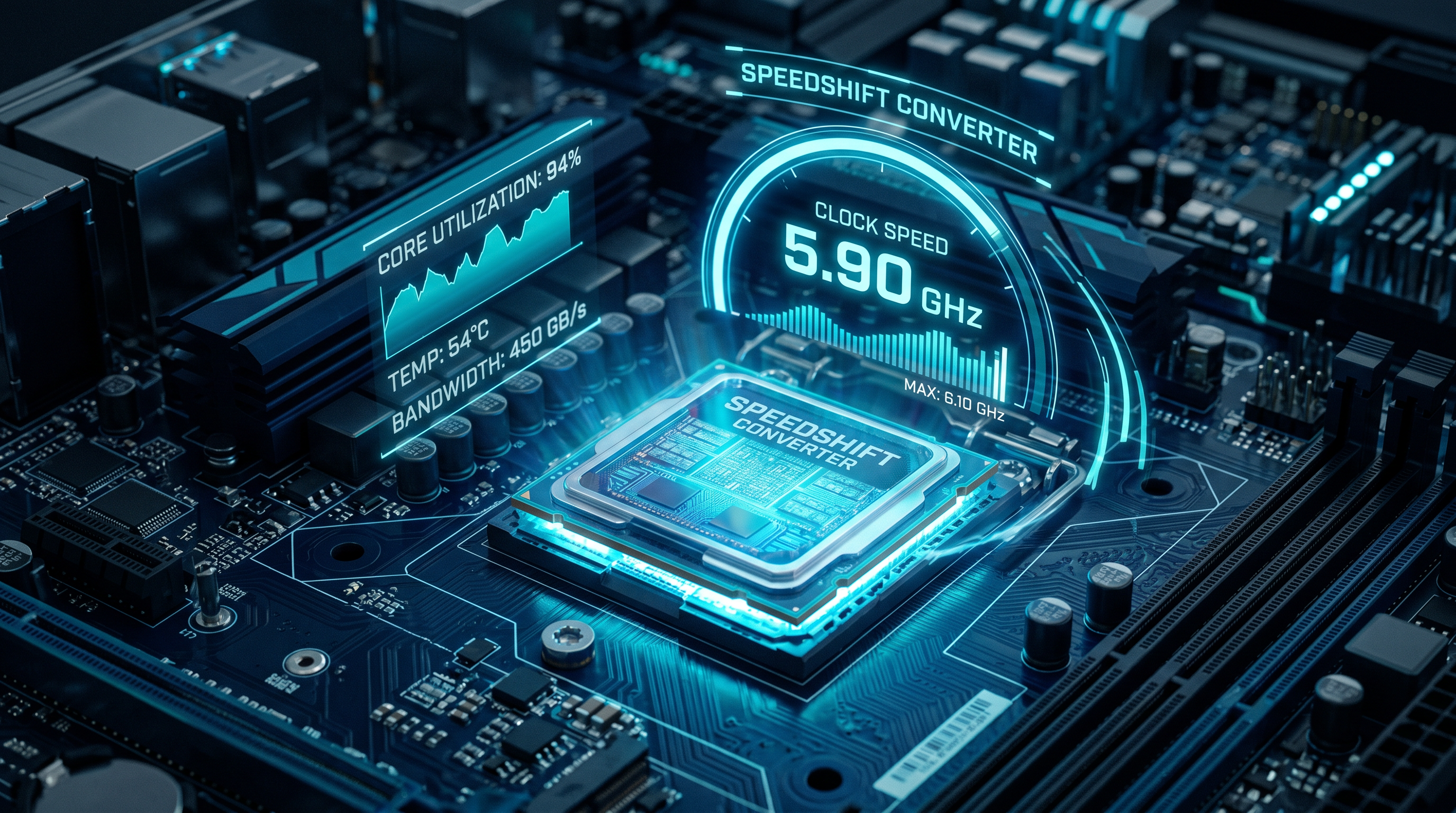
Imagine a microscopic metronome ticking billions of times per second, each beat orchestrating the dance of electrons through silicon veins. That's the essence of CPU clock speed, the heartbeat of every computer, smartphone, and server powering our digital world. But what does gigahertz meaning truly signify? At its core, 1 GHz equals one billion cycles per second—a cycle being the fundamental pulse where the processor fetches, decodes, executes, and stores an instruction.
These cycles aren't arbitrary; they're the rhythm dictating how swiftly a CPU churns through tasks. A 6 GHz chip, like Intel's latest Core Ultra series, pulses 6 billion times every second. Yet, raw clock speed alone doesn't tell the full story of CPU performance metrics. It's the synergy of speed and smarts—how many instructions squeeze into each tick—that unleashes true power. Picture a sprinter: clock speed measures stride frequency, but victory hinges on stride length too.
The Evolutionary Path: From MHz vs GHz in Processor History
The Humble Beginnings: KHz and the Dawn of MHz
Our tale starts in 1971 with the Intel 4004, the world's first microprocessor, humming at a modest 740 KHz—740,000 cycles per second. It was a marvel, fitting 2,300 transistors into a chip the size of a fingernail, powering early calculators. By the 1980s, the IBM PC's Intel 8086 hit 5-10 MHz (millions of cycles per second), enabling spreadsheets and word processors that transformed offices worldwide.
The 1990s ignited the MHz vs GHz shift. Pentium chips climbed to 66 MHz, then 200 MHz, as marketing battles touted ever-higher numbers. Consumers lapped it up: faster MHz meant snappier games, quicker boots. But crossing into GHz territory arrived with the Pentium III at 1 GHz in 2000, a psychological milestone that screamed "future."
Today's GHz Titans
Fast-forward to 2024: AMD's Ryzen 9 9950X boosts to 5.7 GHz, while Intel's Core i9-14900KS touches 6.2 GHz under load. This processor history reflects relentless engineering, shrinking transistors via Moore's Law—from 10 microns in the 4004 to 3 nanometers today—packing more punch per pulse.
The GHz Wars: Glory, Then a Thermal Wall
The early 2000s were the Wild West of silicon, dubbed the "GHz Wars." Intel's Pentium 4 raced to 3.8 GHz by 2004, AMD's Athlon 64 countered at 2.4 GHz but with superior architecture. Ads screamed megahertz supremacy; buyers equated GHz with godlike speed. Yet, physics rebelled.
Cranking clock speeds amplified heat and power draw exponentially. Power density soared—think watts per square millimeter—like cramming a nuclear reactor into a sugar cube. Pentium 4s guzzled 100+ watts, requiring massive heatsinks and fans that roared like jet engines. By mid-decade, the industry slammed into the "power wall": further GHz hikes demanded unsustainable cooling and batteries. Clock speeds plateaued around 3-4 GHz for years, forcing a pivot to multicore designs and efficiency.
Why Clock Speed Misleads: IPC Explained and Architectural Realities
Here's the myth-busting truth: CPU clock speed is a siren song. A 3 GHz chip from 2010 might outpace a 5 GHz newcomer if its IPC explained—Instructions Per Clock—shines brighter. IPC measures work done per cycle: fetching data, crunching math, branching logic.
- Older NetBurst architecture (Pentium 4): Low IPC, ~0.5-1 instructions/cycle, wasting cycles on pipeline bubbles.
- Modern Zen 5 or Arrow Lake: IPC up 15-20% per generation via wider execution units, better branch prediction, massive caches.
Performance = Clock Speed × IPC × Cores. A 4 GHz CPU with 2x IPC equals an 8 GHz sloth. Architects like AMD's Zen team prioritize IPC leaps, blending moderate clocks (up to 5.7 GHz) with high IPC for desktop dominance.
Mind-Bending Facts About GHz Precision
At 6 GHz, light travels just 5 centimeters between ticks—slower than your blink.
Fascinating, right? Each cycle spans 0.167 nanoseconds; in that blink, trillions occur. Or consider: a 1 GHz clock's wavelength stretches 30 cm, why high-speed signals demand precise PCB traces—like instant speed conversion from electrical pulses to computation.
- The Intel 4004's 740 KHz cycle lasted 1.35 microseconds—time for sound to travel 0.4 meters.
- Overclocked extremes push 9 GHz, cycles shorter than atomic vibrations.
Intel vs AMD: Divergent Paths in CPU Performance Metrics
Intel long chased peak clocks, hitting 5.5 GHz first, but AMD flipped the script. Ryzen's chiplet design scales cores affordably, blending 5+ GHz boosts with sky-high IPC. Intel's hybrid P+E cores (performance + efficiency) juggle workloads smartly. Result? AMD leads multi-threaded tasks; Intel edges single-threaded bursts. Both embody CPU performance metrics evolution beyond raw GHz.
Overclocking Records: Pushing GHz to the Edge
For thrill-seekers, overclocking shatters limits. Enthusiasts void warranties, armed with liquid nitrogen at -196°C. Records dazzle: AMD's Ryzen Threadripper hit 8.7 GHz in 2023; Intel's Core i9-13900K scaled 9.12 GHz briefly. These feats demand custom loops, delidded chips, and nerves of steel—proof silicon's headroom, but daily drivers stick to stock 6 GHz for stability.
Mobile GHz: Why Your Phone's 3+ GHz Isn't PC Parity
Snapdragon 8 Gen 3 or Apple A18 Pro prime at 3.4-4 GHz bursts, yet lag desktop renders. Trade-offs rule: mobiles prioritize efficiency over brute force. ARM architectures sip power (5-10W vs 250W desktop), big.LITTLE clusters toggle high/low clocks dynamically. Thermal throttling kicks in fast on slim phones—no room for GHz marathons. Still, optimized software bridges gaps, making mobiles feel blisteringly fast.
The Future of CPU Clock Speed: Beyond 6 GHz?
Whispers of 7-8 GHz stock speeds loom with 2nm nodes and backside power delivery slashing resistance. Chiplets, 3D stacking, and AI-optimized silicon promise IPC surges. Quantum dots and optical computing tease cycle-less futures. Yet, the power wall endures—sustainability demands balanced CPU clock speed.
From 740 KHz origins to GHz glory, clock speed chronicles human ingenuity. Next time you hear 6 GHz, remember: it's not just ticks—it's the universe computed, one precise cycle at a time. What boundary will silicon breach next?